|
|
|
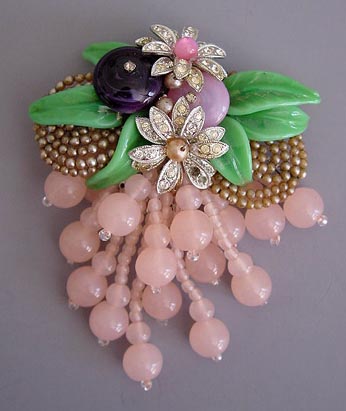
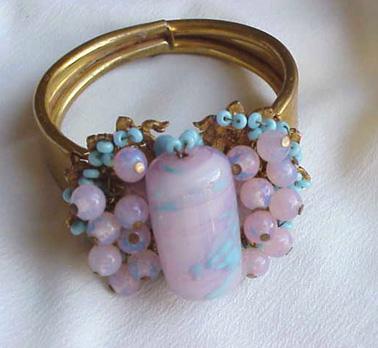
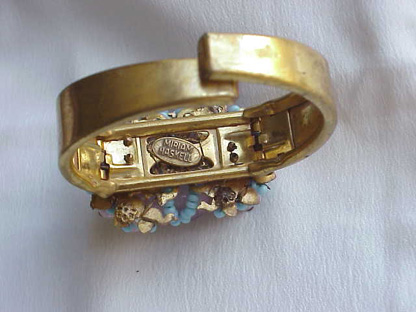
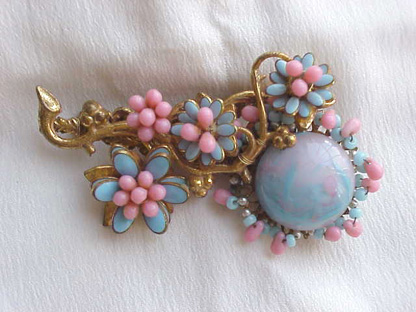
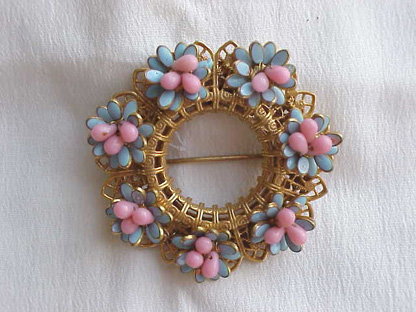
Unsigned HASKELL by Frank Hess
from the 1930’s and 1940’s
|

|
|
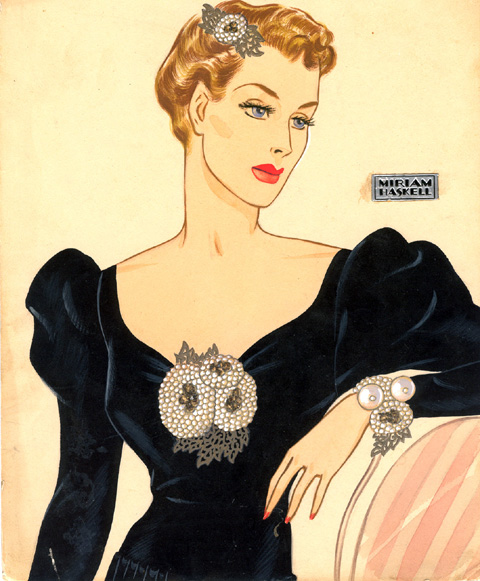
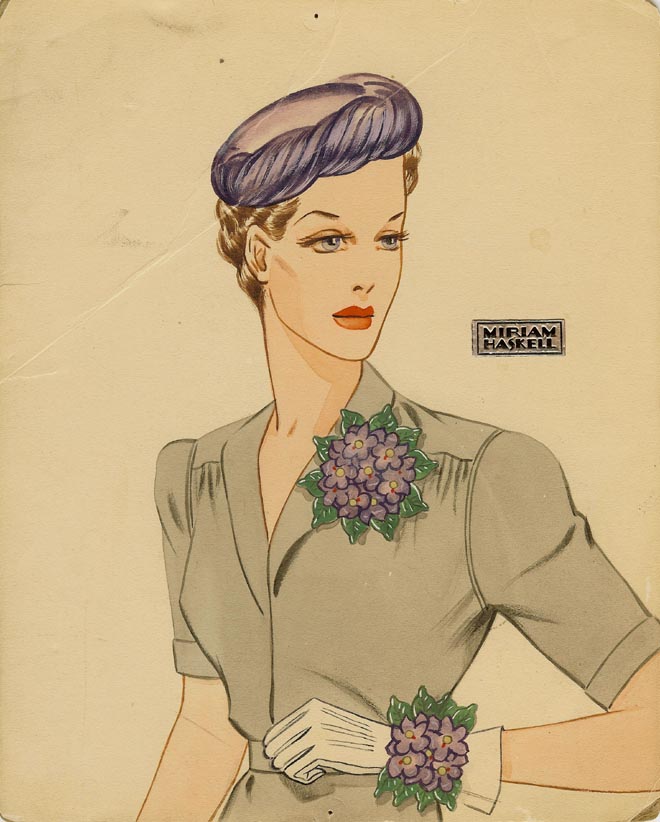
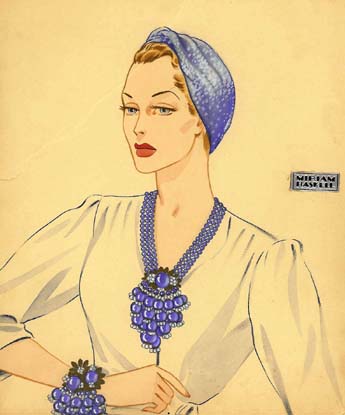
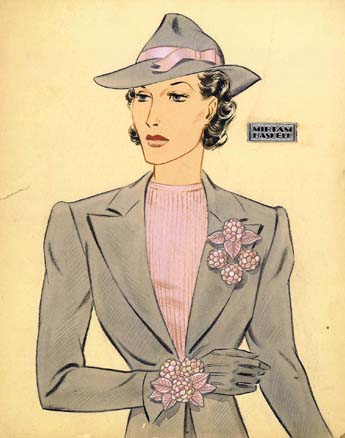
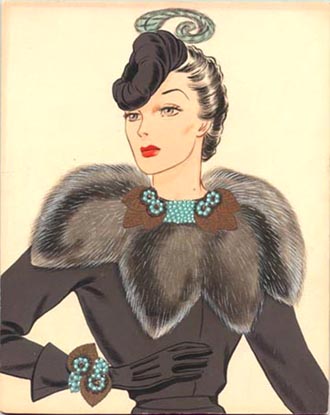
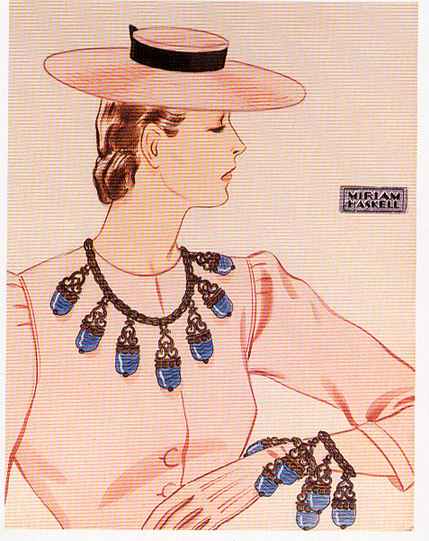
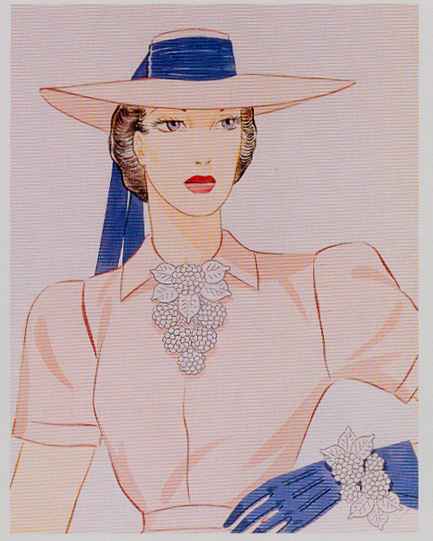
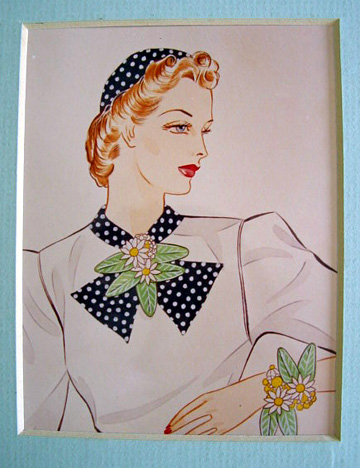
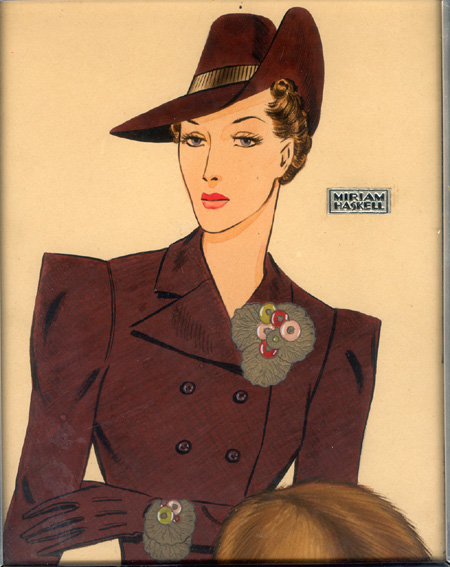
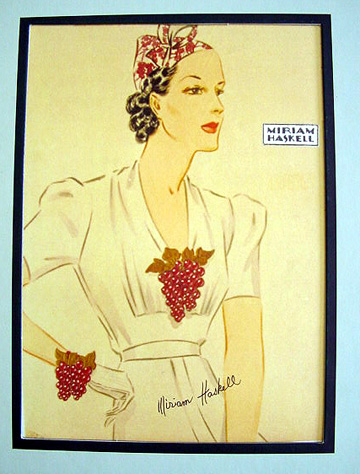
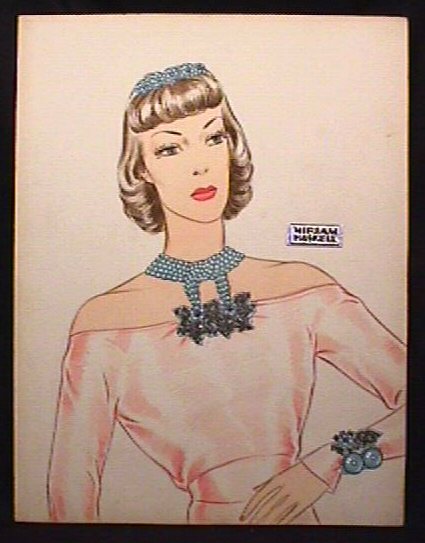
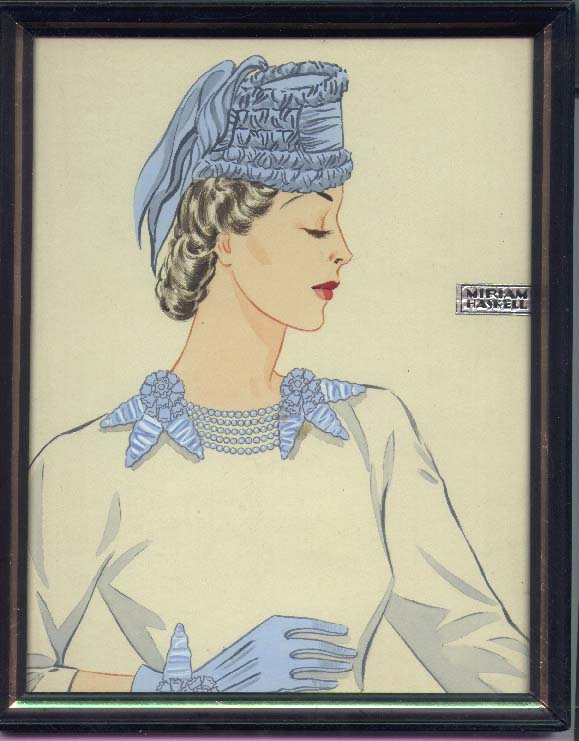
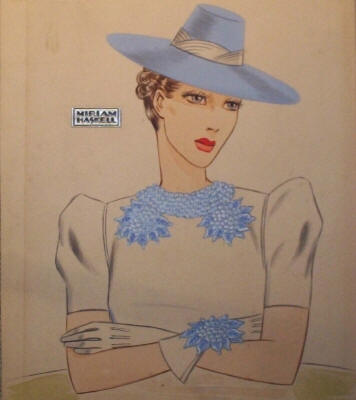
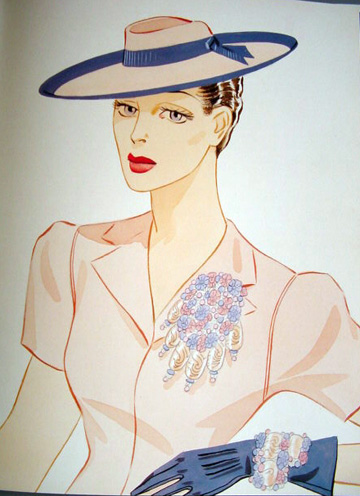
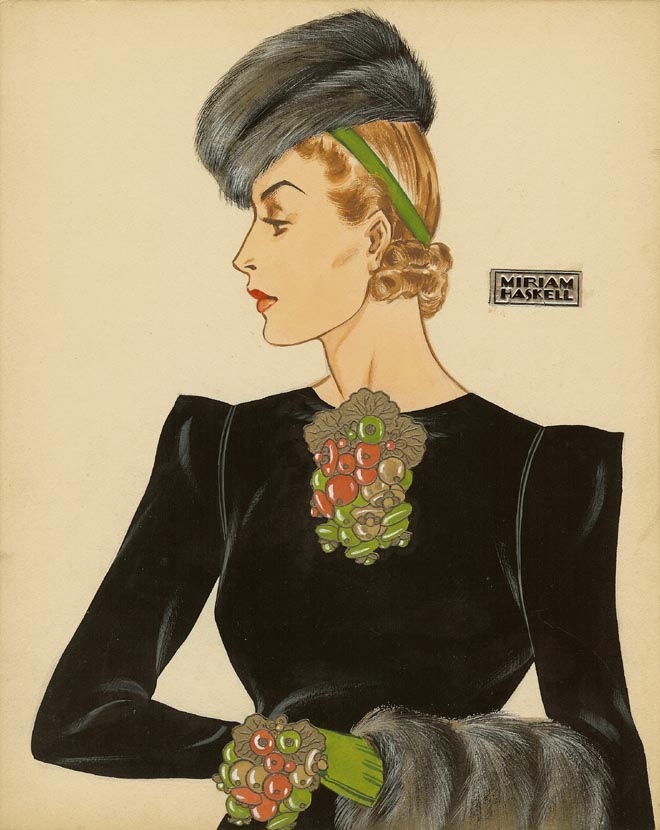
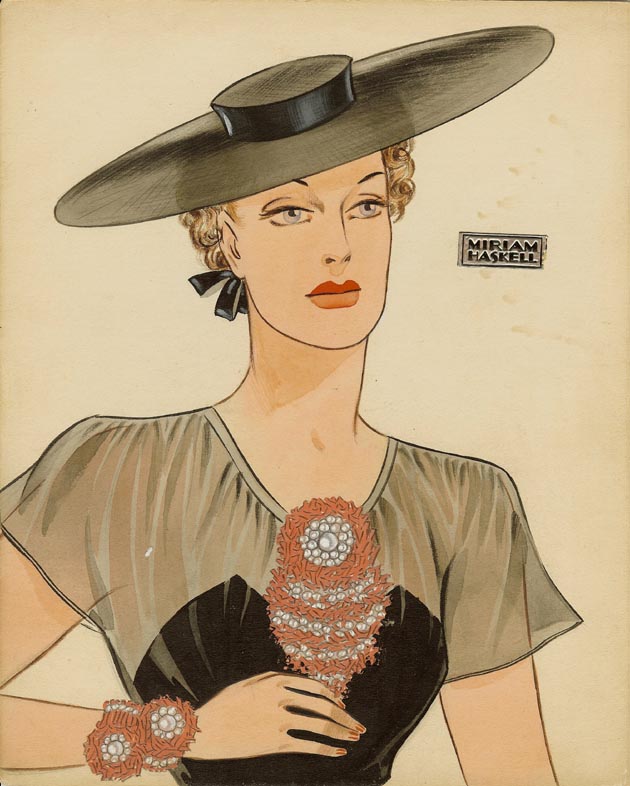
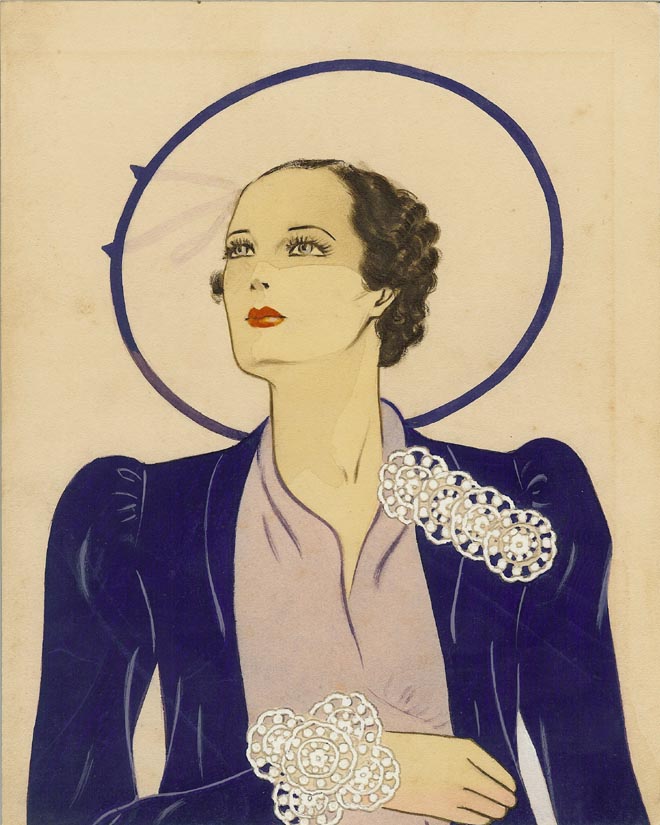
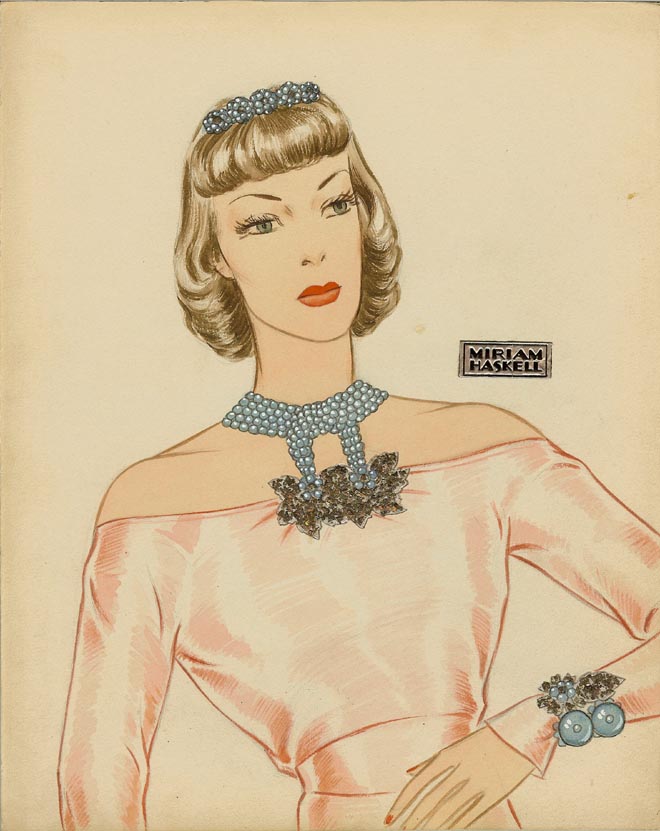
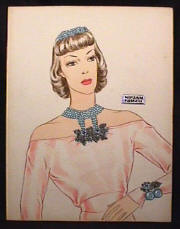
HASKELL ads from the 1940’s. Water color artist Larry Austin did these to be used as advertising for Haskell
jewelry, and they show many of the wonderful unsigned pieces from the
early days of Miriam Haskell Jewelry .
|
|
I sign my
name "Jane H. Clarke", and was asked several years ago if the "H" stood
for "Haskell" because I am known a lover of Haskell jewelry. (It doesn’t…
it stands for Haley, my maiden name.) Haskell pieces are diminutive treasures with their artistic designs, beautiful hand work and rainbow of colors.
It has been
a delight to do the research for this article. I have had the
pleasure of sharing pictures from my own collection, and Cathy
Gordon and Mary Ann Legan were kind enough to share many fabulous pictures
from their collections, as well as their comments. Without them, this
article would not have been possible.
Camela "Millie" Petronzio, Larry Vrba
and Bertl Groll all gave us the benefit of their years of experience with
Haskell Jewelry. We cannot thank them enough for their insights.
Haskell is the attributed maker for many of these pieces, but none are
signed. Attributing unsigned jewelry is often difficult, so where possible I have shown old Haskell
advertisements and/or other documentation. While beads and findings may be
used as clues, they are not definitive. (An example of why can be seen in
the comparison of a Haskell and an Amourelle necklace at the end of
this article).
Note: These items were
photographed from private collections, and are for reference only.
Jewelry that is available for sale can be
accessed at the links at the bottom of the page.
|
|
MIRIAM
HASKELL… the name alone conjures up images of
tiny faux pearls, glass beads and rose montees fashioned into tapestries
of dazzling jewelry. During the early days of her jewelry making in the
1930’s and 1940’s, many pieces were unsigned. Now the hunt for them is
inspired by her wonderful sense of design, her intricate craftsmanship and
the mystery of what IS and what is NOT Haskell.
Some pieces we will never be able to identify positively… the attribution of
unsigned jewelry is always chancy… but we would like to share with you what we
have deduced, and solicit your input, too.
|
|
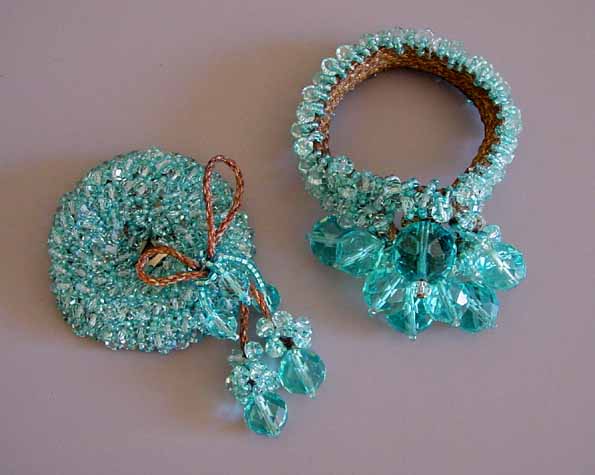
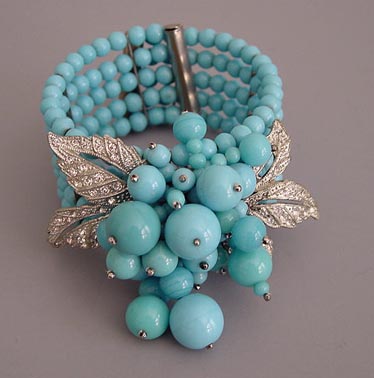
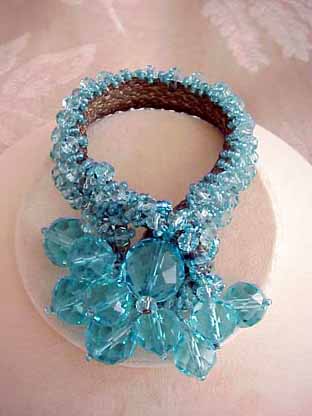
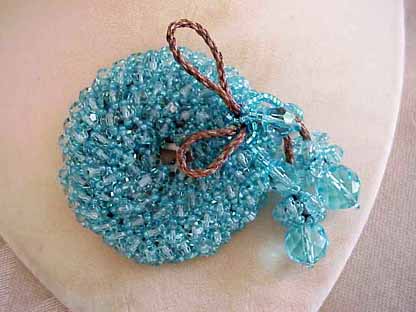
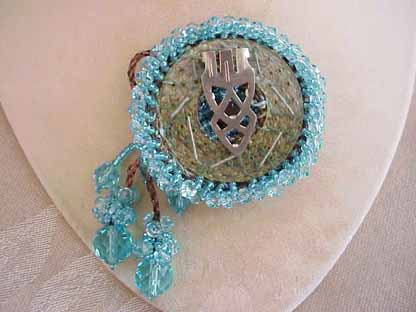
HASKELL Hess early unsigned aqua faceted crystal beaded dress clip and bracelet.
This has hundreds of tiny aqua transparent glass beads that wrap around the
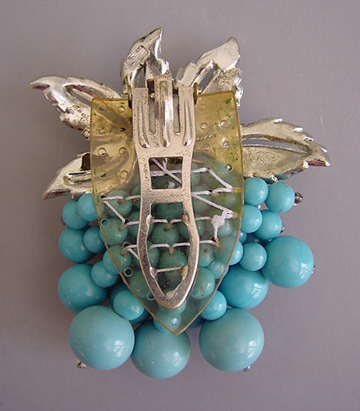
dress clip and the wire mesh bracelet. On the back, the perforated clear
plastic support and metal clip are typical of the World War II to 1950’s
era.
View
View
View
#H19738 |
HASKELL
Original watercolor written in pencil on the back #667 |
Advertisement
illustrates the same beads used in the clip shown in the photo to the right,
center clip. HASKELL
CLIP #H19736 |
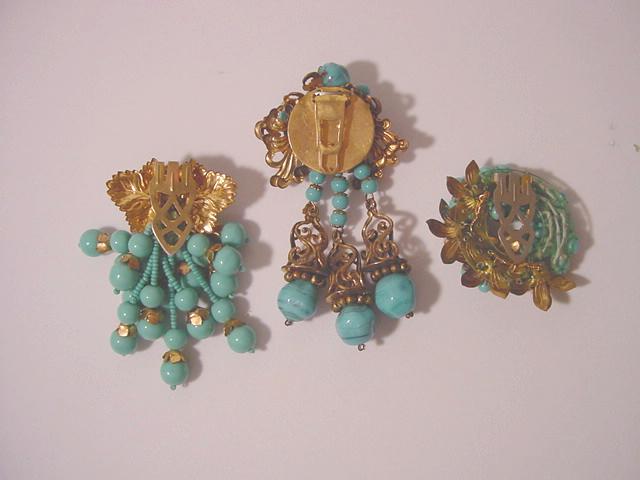
CLIPS with
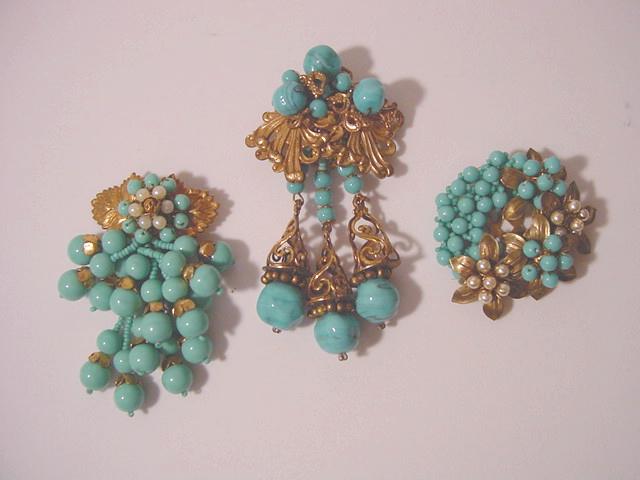
aqua glass beads and gold tone metal leaves with flower-cup findings hold
aqua glass beads in different sizes in each of the three clip
Back
center HASKELL
CLIP
#H19736 |
|
Notice how all these pieces are finished. The use
of different sizes of glass beads, the finishing of each string of beads
with a tiny seed bead, and style of the gold tone findings are all clues
to the maker. Haskell made dress clips in the
1930’s and 1940’s . Necklaces, bracelets and earrings were made to
match these dress clips, but now they seem even more difficult to find than
the dress clips.
|
|
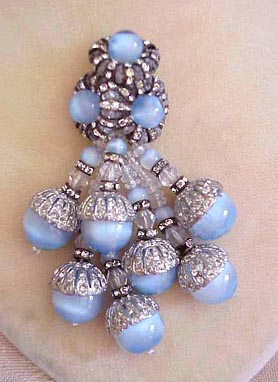
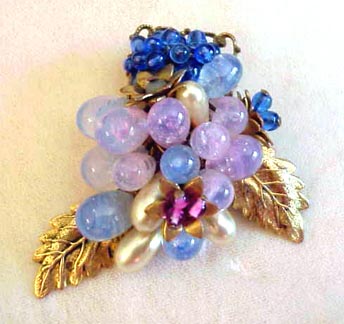
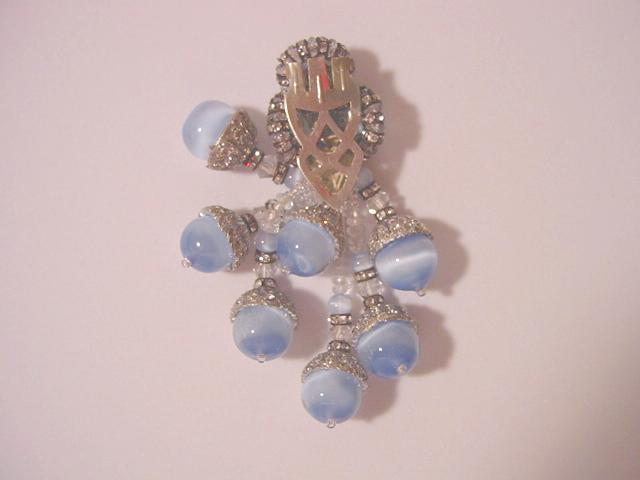
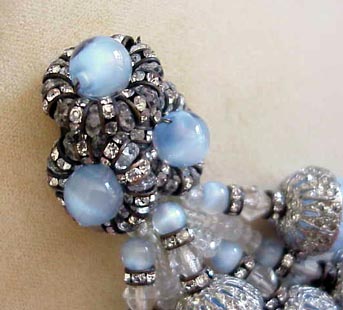
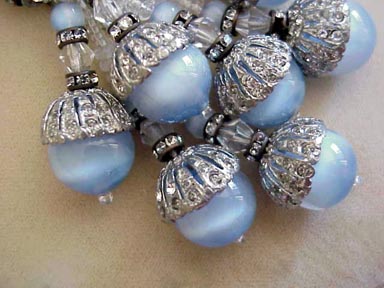
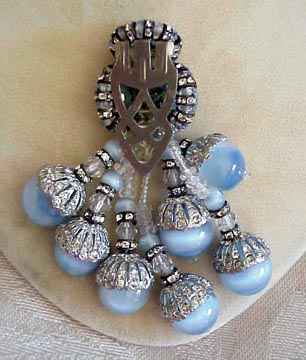
Pastel blue "moonstone" glass beads 2-7/8"
dress clip highlighted
with rhinestones and roundelles… what a combination! Again, note the
tiny seed beads at the tip of each strand. |
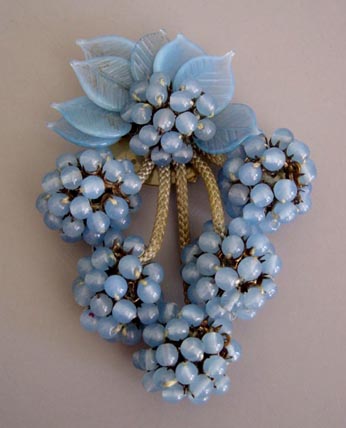
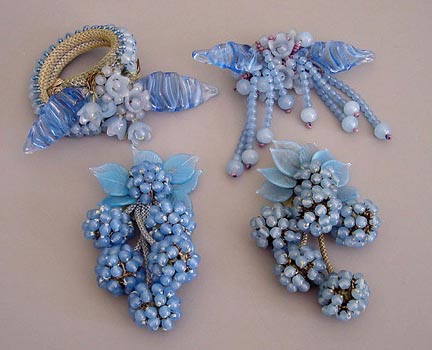
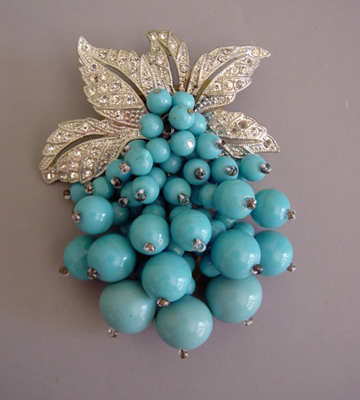
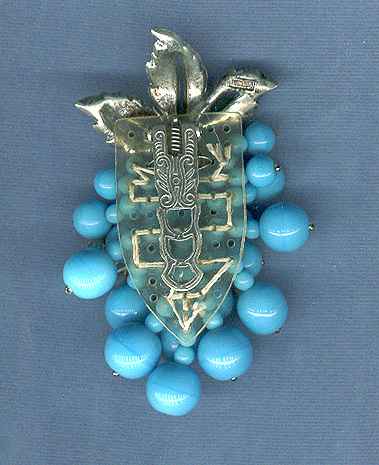
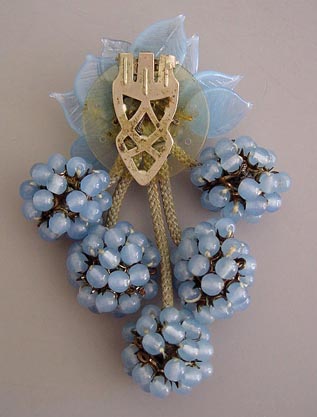
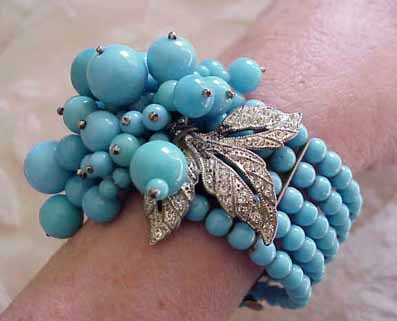
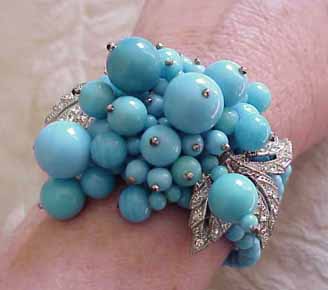
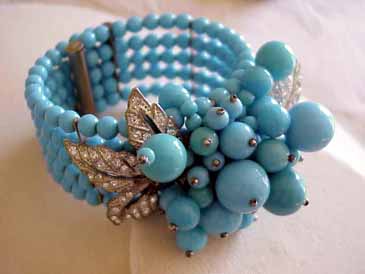
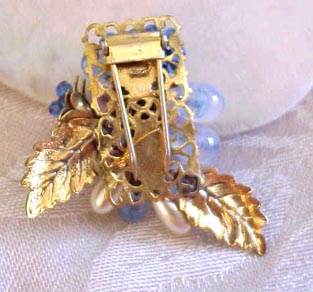
This lush
dress clip looks like a fantasy sky-blue grape cluster. These
beads and pressed glass leaves are seen in later Haskell creations and
demonstrate the fact that Haskell sometimes bought findings and beads in large lots
and used them over a long period of time, which can make dating difficult. |
The advertisement for this dress clip and the matching bracelet is on page 21 of
Deanna Cera’s The Jewels of Miriam Haskell, and shown above. It is
dated 1937 and attributed to Frank Hess. #H19702 |
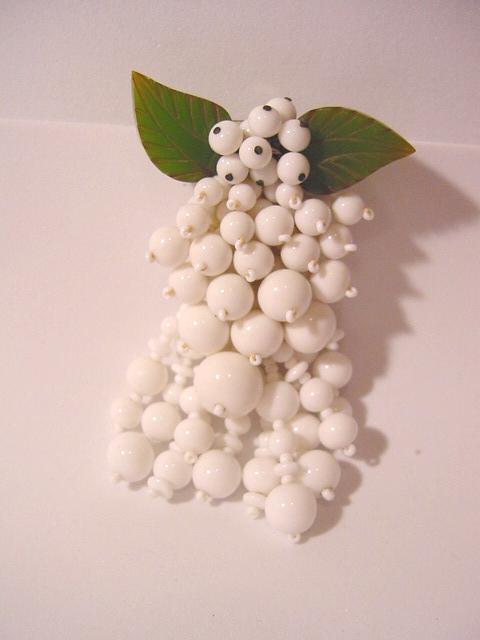
This snowy white cascade of small-to-larger glass beads suspended from
bakelite leaves is finished off with a tiny bead at each tip. This is the
kind of detailing that makes Haskell so artistically desirable.
#H19701 |
|
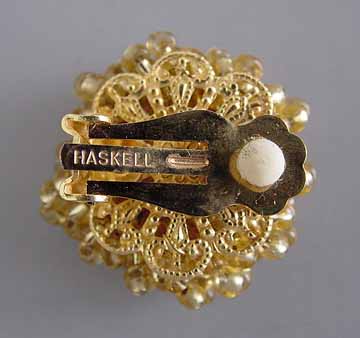
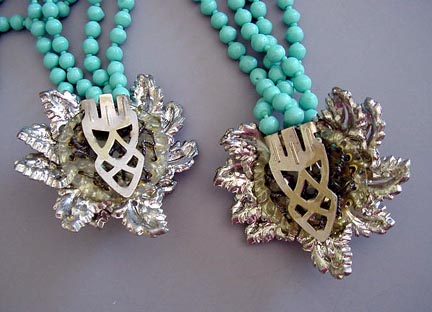
Millie says although the shape of the logo tag is not always a definitive method
of dating, in
general the horseshoe shaped mark was used in the late 1940’s through the
1960’s. The more common oval shaped mark was used from then to the
present.
Old Haskell advertisements are a way of documenting unsigned pieces. Most
of them, as you can see by the ones shown in this article, were actual
pictures of real jewelry designs, not just generalizations.
|
|
In the 1940’s the switch was made to the "French clip", the
thinner wire clip back we see on many older Haskell earrings. |
The "flat back clip", the clip back style used by many costume
jewelers even today, was used first in the earlier years, usually due to
the heavier weight of the earrings. |
In the 1950’s, as a result of complaints that the other style
was too uncomfortable, Haskell changed to the use of the "screw back-clip"
earrings. |
This is the earrings back most commonly used in Haskell jewelry
today. |
|
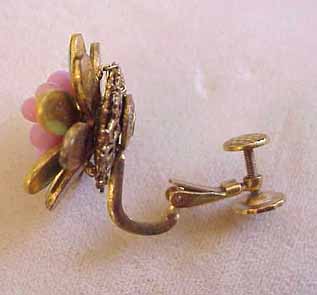
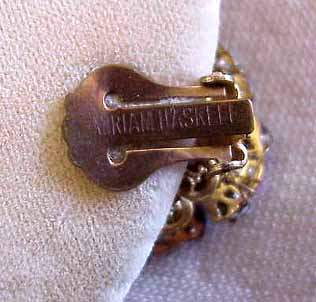
According to Millie Petronzio, another clue for dating is the style of earring back.
The "flat back clip", the clip back style used by many costume
jewelers even today, was used first in the earlier years, usually due to
the heavier weight of the earrings.
In the late 1940’s the switch was made to the
"French clip", the thinner wire clip back we see on many older
Haskell earrings.
In the 1950’s, as a result of complaints that the
other style was too uncomfortable, Haskell changed to the use of the
"screw back-clip" earrings.
In about 1980, they returned to
the use of flat back clip earrings.
|
|
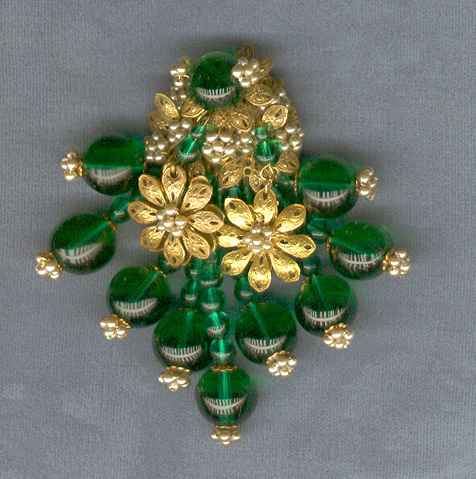
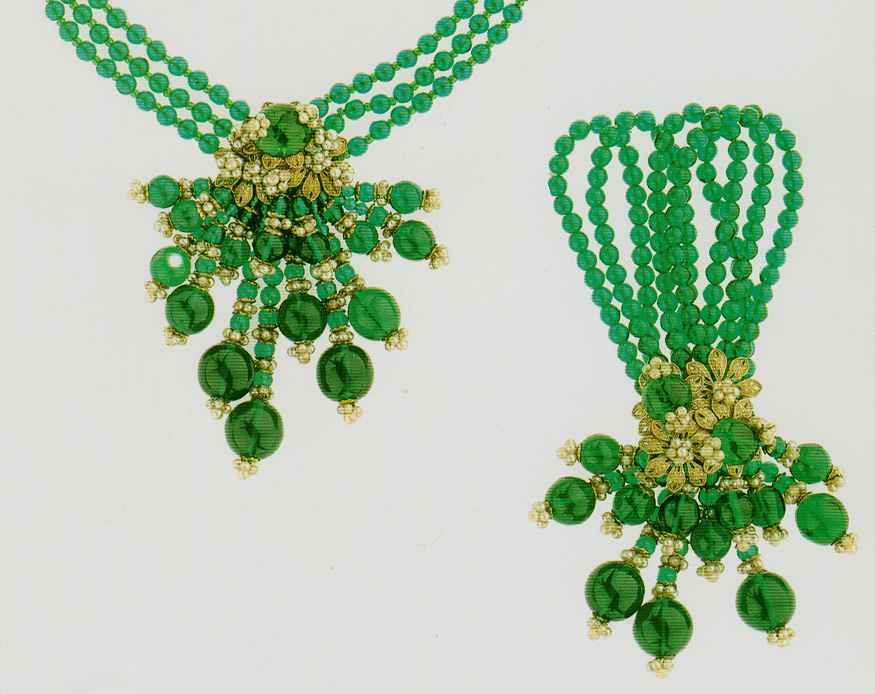
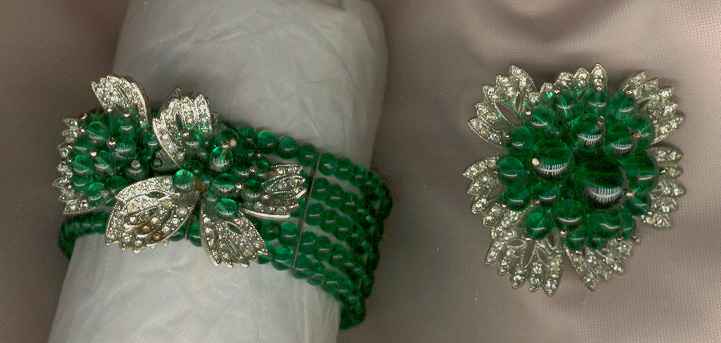
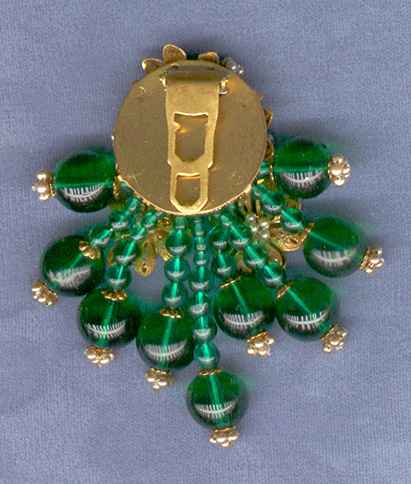
The green glass beads and faux pearls dress clip is lovely, and on page 79 of Deanna Farneti Cera’s
The Jewels of Miriam
Haskell you can see the matching necklace and bracelet set, designer
Frank Hess circa 1940.
|
|
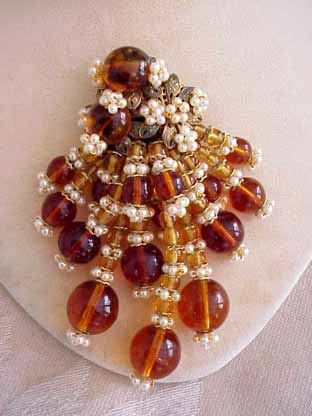
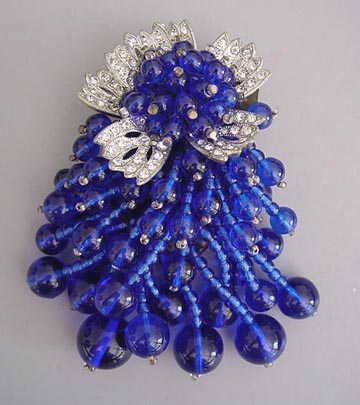
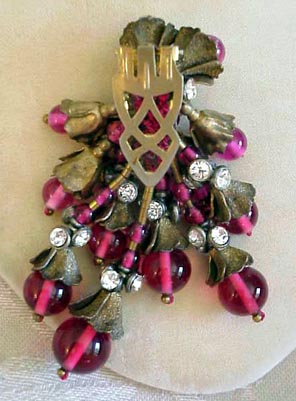
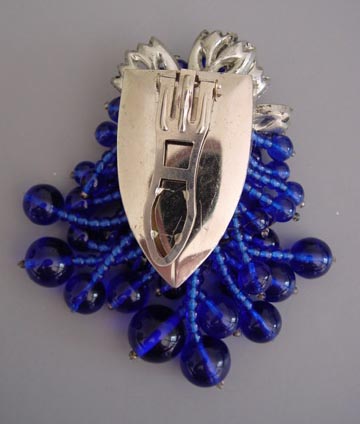
Haskell early
unsigned 3-1/2" cranberry glass beads and clear rhinestones dress clip,
typical Haskell findings and finish work. View
View
View #H19938 |
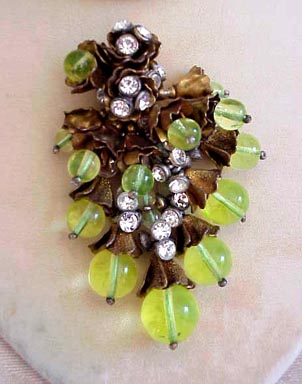
Haskell yellow glass
bead 3-1/3" dress clip. #H19942 |
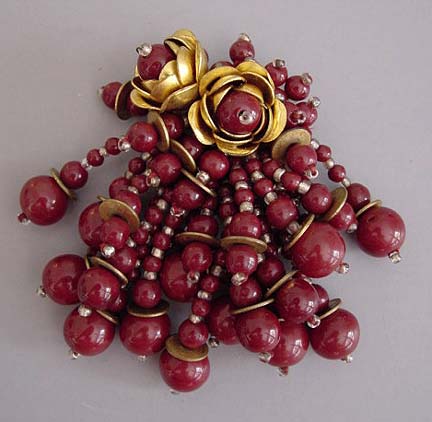
Haskell early
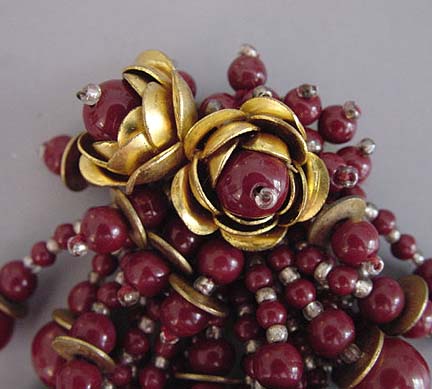
unsigned maroon glass beads dress clip 3" long.
View
#H19943 |
|
These sets use a gold tone metal floral motif in the findings. Note the similarity of
the beads and findings of the clips on the left and right to this parure
by Frank Hess from the 2nd half of the 1930s. From Cera, The Jewels of Miriam
Haskell, Page 87
"The use
of clips not just as a lapel ornament but also as the central feature of a
necklace was very common during the years between the two
wars." From Cera, The
Jewels of Miriam Haskell, p. 25. Both Bertl and Millie say there were far
more dress clips made than fur clips.
There were five fashion seasons every year, with collections made for
each season. There could be ten to twelve lines in each collection, with
multiple necklaces, bracelets, brooches, dress clips and earrings for each
line. Colors and style changed seasonally, just as they do today.
|
|
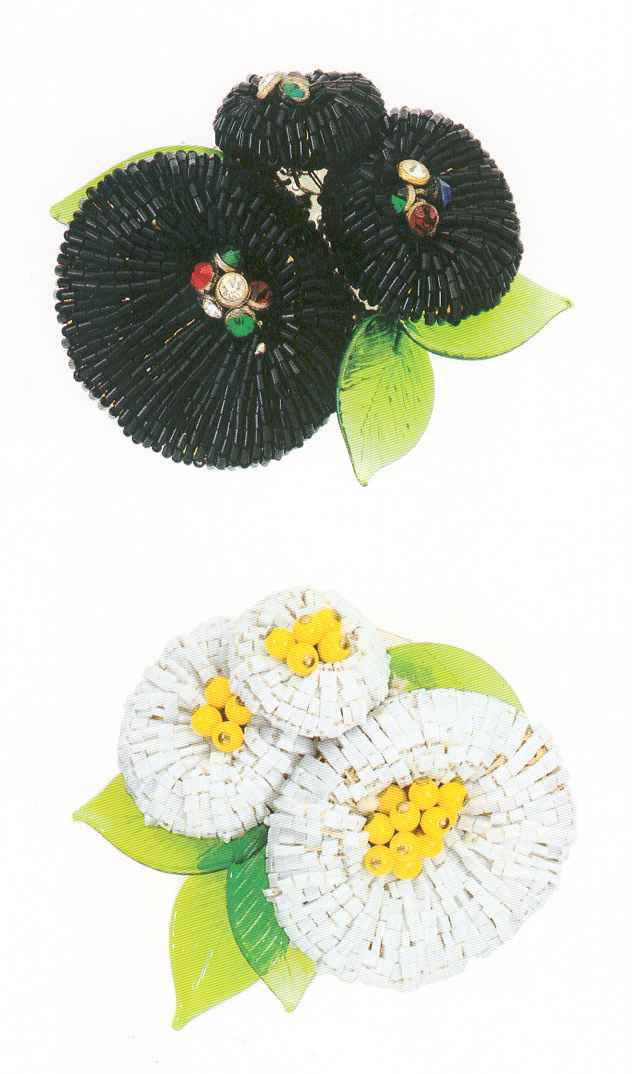
On page 76 of Deanna Farneti Cera’s The Jewels of Miriam Haskell
are photographs of two dress clips in the same style as the beautiful blue
example shown above.
One is done in black beads and the other in yellow and white, with both
attributed to designer Frank Hess, circa 1938. Cathy Gordon has a
necklace in this same style, VIEW
HERE.
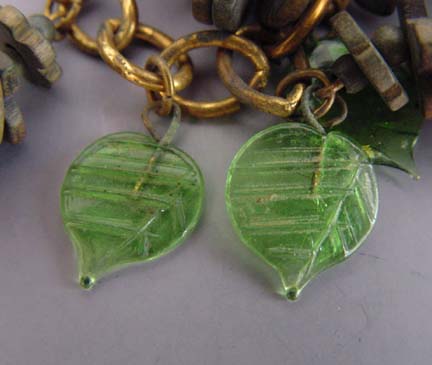
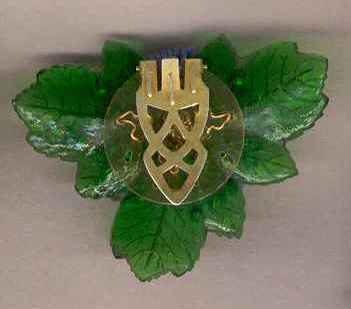
Interestingly enough, however, the pressed glass leaves from Cera’s
pictures look very different from the ones shown here on the blue clip.
Note, though, that the back of the blue clip shows atypical
Haskell-style metal clip and clear plastic mounting circle.
The matching necklace is interesting because it has a non-detachable clip on
the center element. The woman of style could clip the necklace in an
asymmetrical fashion if desired. Note the filigree gold tone floret and
the slightly flattened shaped glass beads, both of which are typical
Haskell elements.
|
|
HASKELL
early unsigned Frank Hess design from the 1940’s. This dress clip of green
glass beads is 3-3/4" long. View
#H19699 |
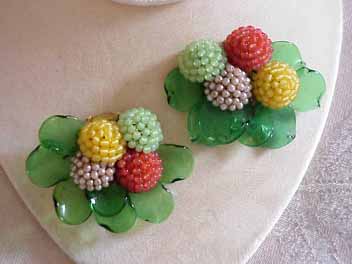
HASKELL
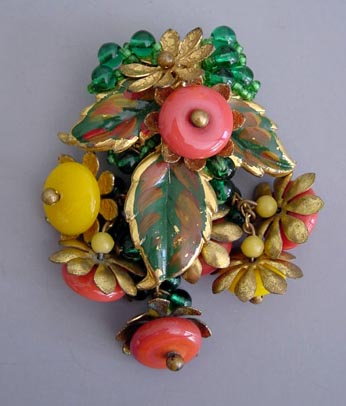
early unsigned dress clips with poured glass leaves and citrus-colored
glass beads. (These were purchased directly from Haskell Jewels’
collection of early pieces.) View
#H19561 |
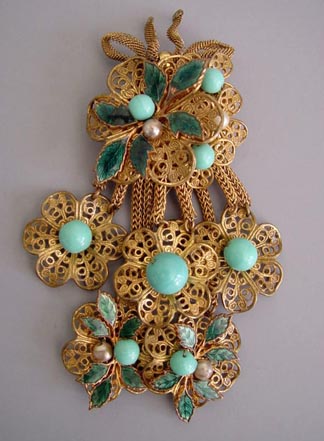
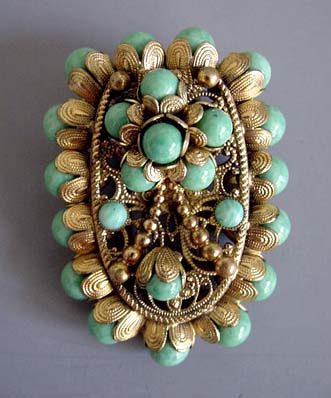
HASKELL
early unsigned dress clip with gold tone filigree backing, aqua glass
beads and green enameled leaves. These same enameled leaves are seen
in later years in some of Bob Clark’s designs. View
View #H19521 |
|
 |
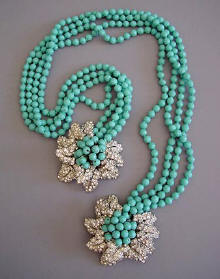 |
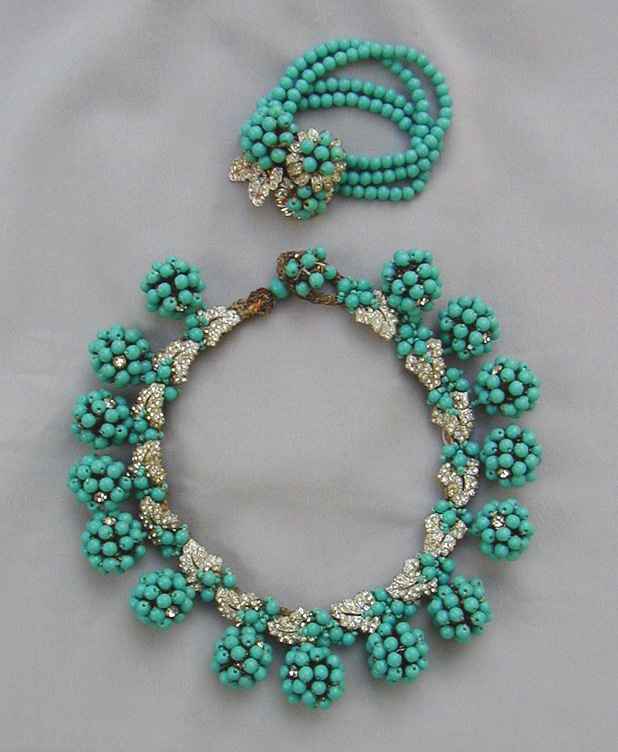
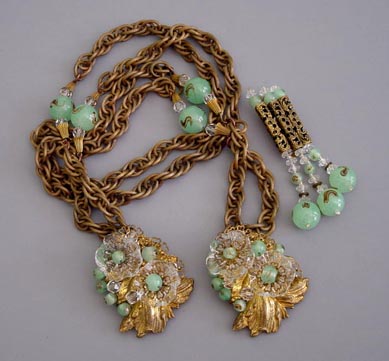
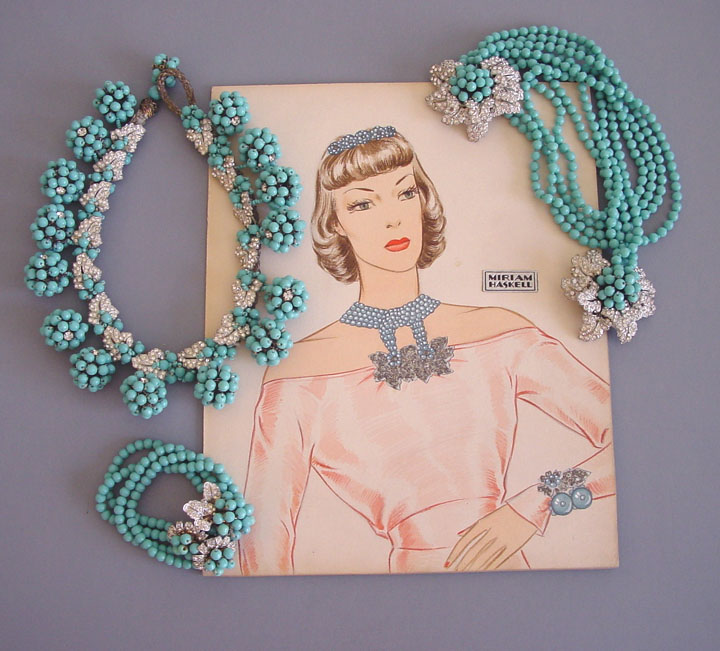
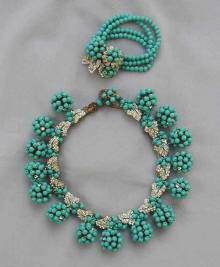
On the right is an early Haskell unsigned necklace and bracelet set with
aqua glass beads and clear rhinestones.
On the left, the matching lariat necklace/clips combination which is also
shown in the Larry Austin advertising art work, far left.. |
 |
|
Larry Austin art work is a wonderful way to identify Hess
Haskell unsigned jewelry. |
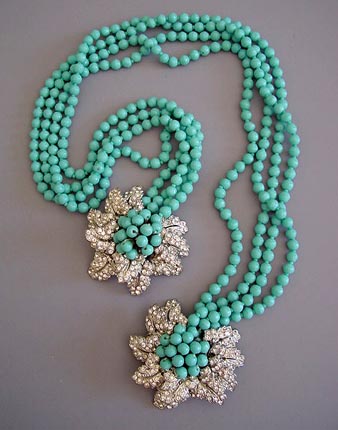
HASKELL early
unsigned aqua glass beads wrap necklace with rhinestone pave leaves, 21"
with 2" dress clips. View
View #H23378 |
|
HASKELL aqua glass beads
and clear rhinestone leaves parure including the original Larry Austin art
work that illustrates it, seen HERE. |
|
CLIP
Back
|
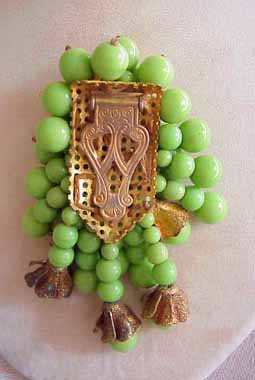
CLIP gold
tone clip with green glass beads, 2-1/2".
View #Y25126 |
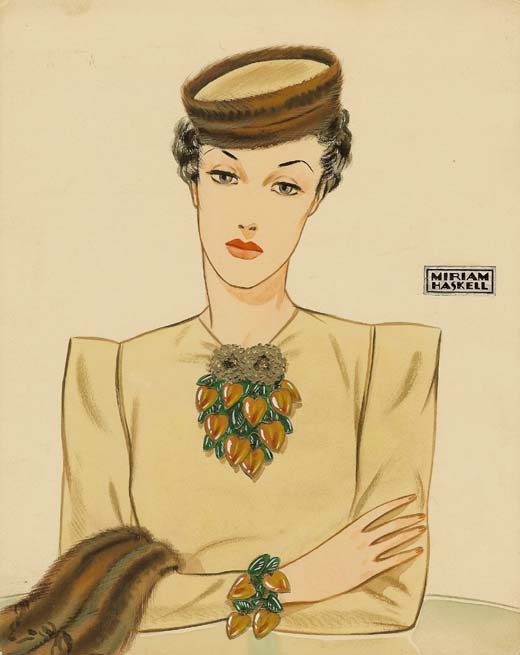
HASKELL
original gouache art work by Larry Austin. Advertising Miriam Haskell jewelry, a
bracelet and dress clip with heart-shaped glass beads and pressed glass
leaves, numbered "#82" in pen on the back, 8" by 10". #H31845 |
Wrap
necklace/clips View
View
View
#H19486
HASKELL
CLIP
Back
#H19703 |
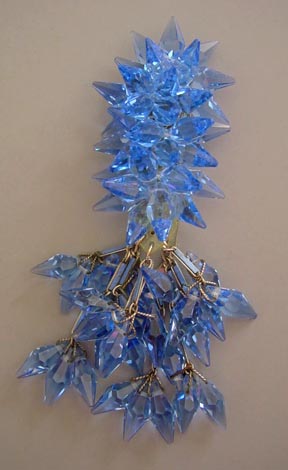
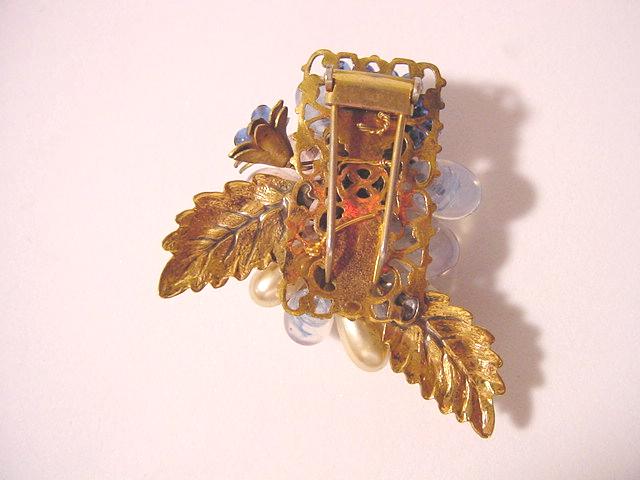
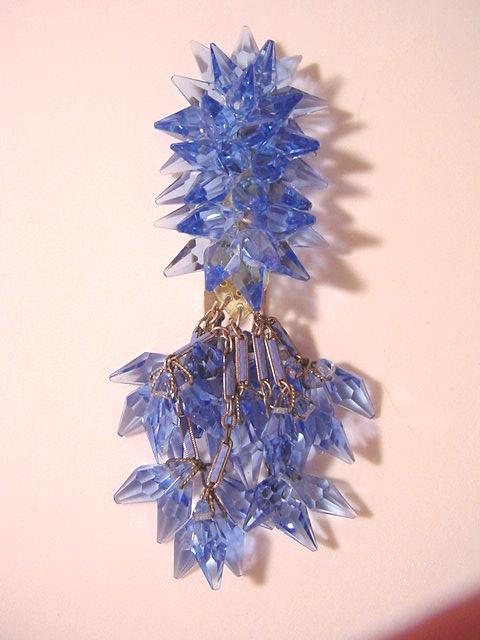
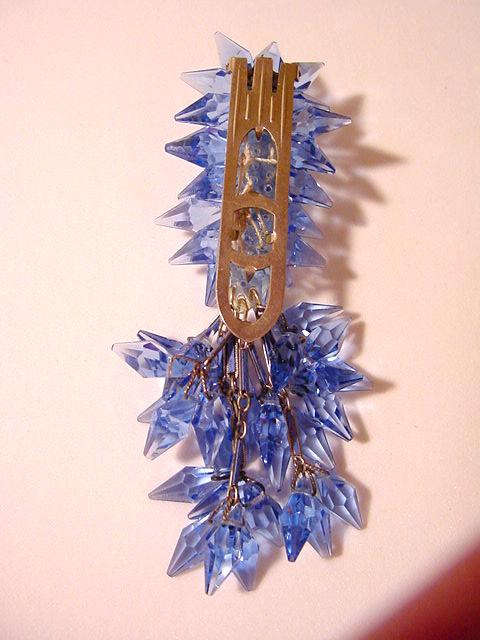
HASKELL early
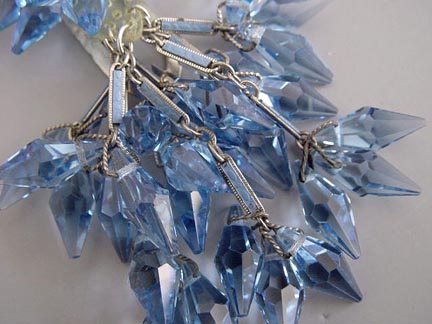
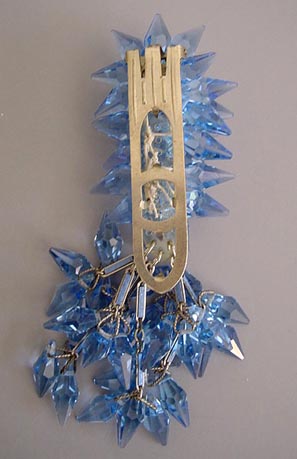
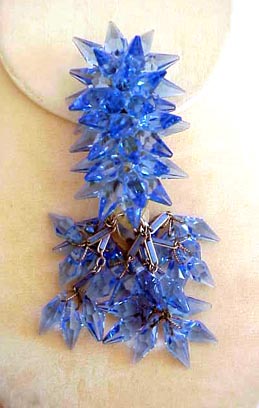
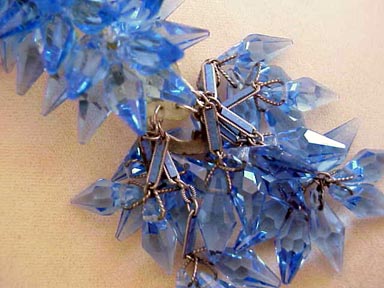
unsigned blue faceted glass crystal beads cascade from this 4-1/4" dress clip
with enameled connecting links. The faceted beads are very high in quality. The
clip back is different, but many of the design elements are Haskell-like,
and Bertl Groll identified this as a Haskell piece.
View
View
View
View #H19939
|
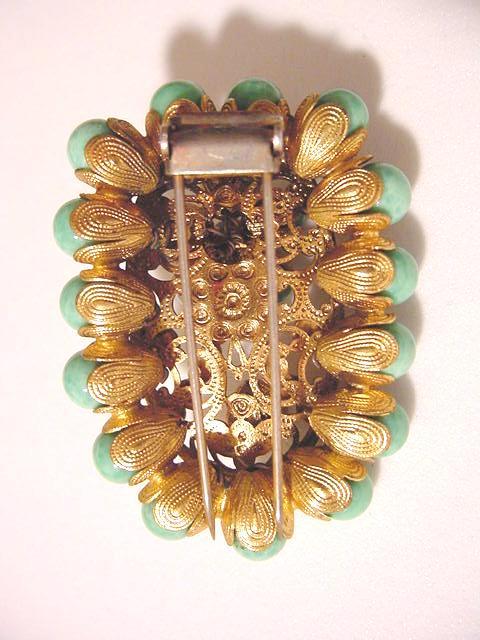
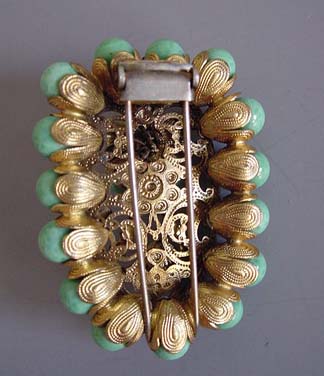
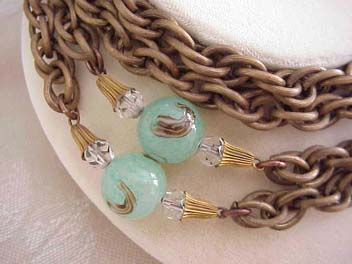
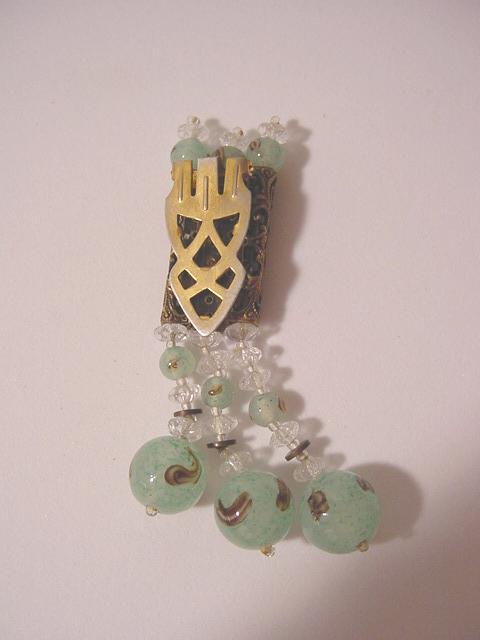
Green marble-like beads are set into gold tone cups in this design.
This clip has some of the characteristic Haskell materials (beads, center
"flower," etched brass) but Bertyl says this it is NOT Haskell. |
Larry Austin art work is a wonderful way to
identify Hess Haskell unsigned jewelry. |
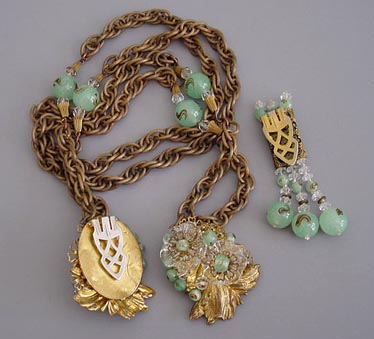
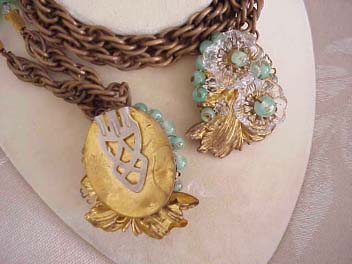
The matching necklace is a lariat style,
with clips on each end, designed by Frank Hess for Miriam Haskell.
|
|
Larry Austin watercolor used as an advertisement for the set shown
here at right. View
HASKELL Larry Austin original
watercolor advertising illustration for Haskell bracelet and
clip/necklace of pastel blue glass leaves and beads, marked in pencil on
the back "930A" and "left", 8" x 10". #H27268 |
HASKELL
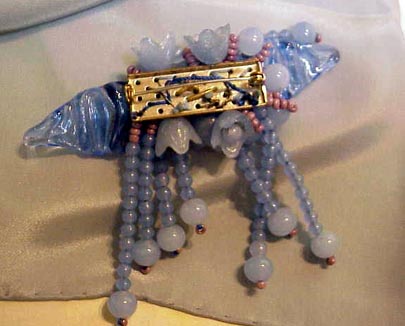
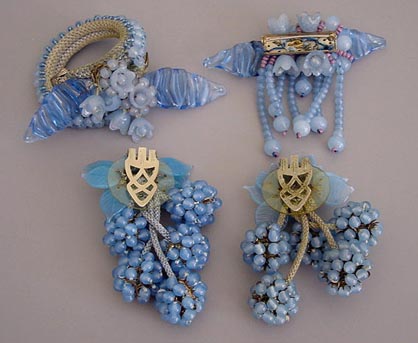
early Hess unsigned dress clips and coil bracelet made of baby blue glass beads and poured
glass leaves. View
#H16620 |
HASKELL early Hess dress clip in baby blue glass beads and poured
glass leaves, 4".
Back
#H24298
HASKELL
Larry Austin original watercolor advertising illustration for Haskell
pink glass beads and leaves bracelet and clip, foil "Miriam
Haskell" sticker, 8" by 10", written in pencil on the back
#615. #H24366 |
|
HASKELL Attributed to designer
Frank Hess, the necklace, bracelet and clips date to about 1940.
View
View
View
View
View
View
#H12331 |
On pages 84-85 of Deanna Farneti Cera’s The Jewels of Miriam
Haskell are photographs of this water color drawing by Larry Austin,
used as an advertisement,. |
HASKELL
transitional
art glass and
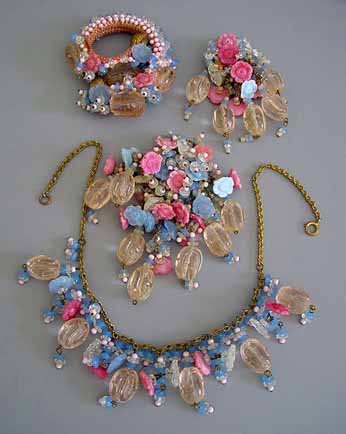
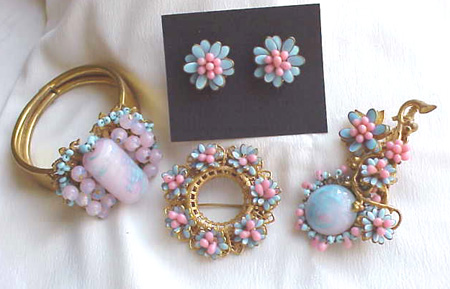
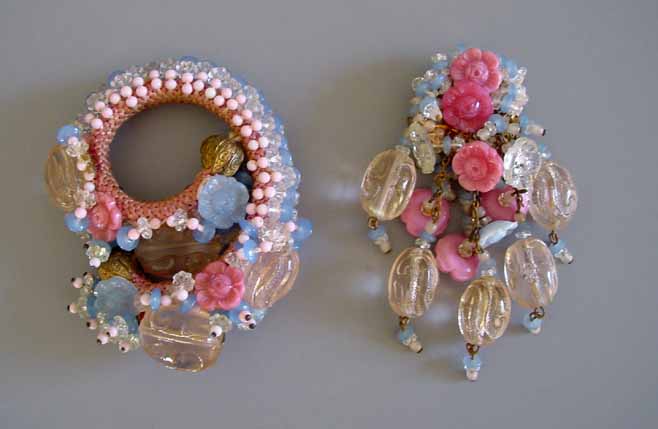
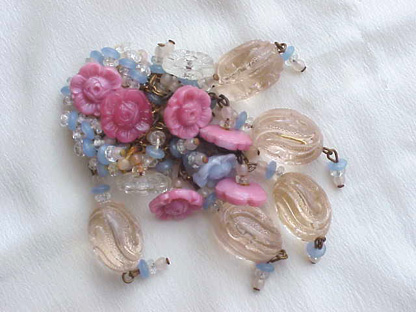
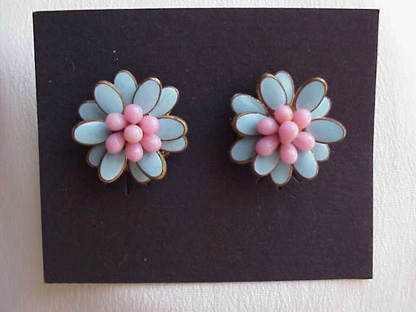
seed beads and enameling in dainty pink and blue. Some of these
transitional pieces are signed and some are not. View
View View
View
View
#H8872 |
|
HASKELL
early Hess unsigned dress clip. #H18844 |
HASKELL
26"
lariat necklace with 2" clips at each end, 15" necklace and 3-3/4" fur clip.
View View
View View
View #H19404 |
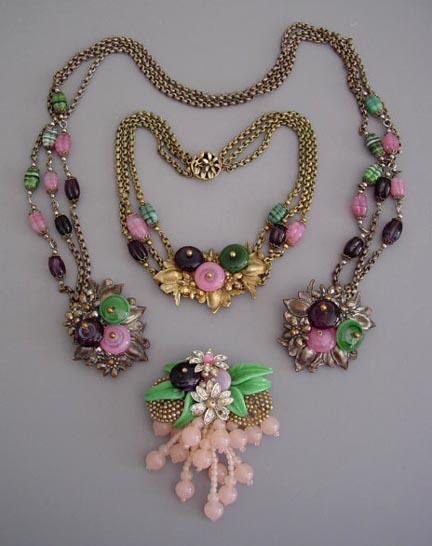
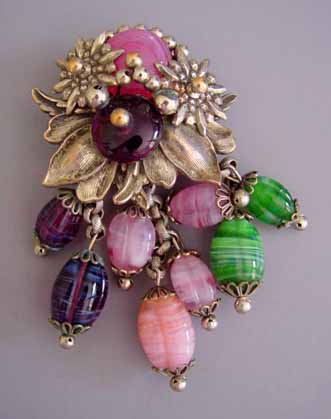
HASKELL early
unsigned purple,
green and pink beaded 3" dress clip with silver tone leaves.
View #H21831 |
|
Pieces matching the pink clip on the left and the
necklace in the middle are shown on page 73 of
Deanna Farneti Cera’s "The Jewels of Miriam Haskell", designed by Frank Hess circa 1939. The
clip is also shown on the bottom right of the cover of her book.
|
|
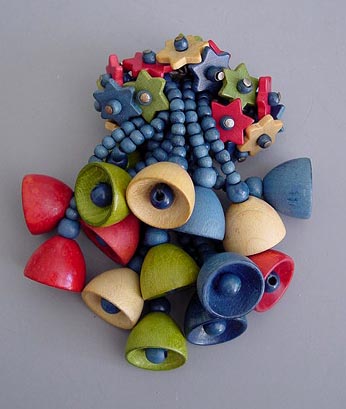
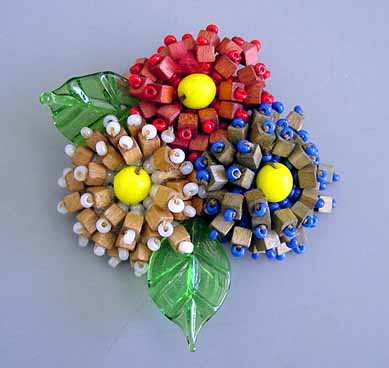
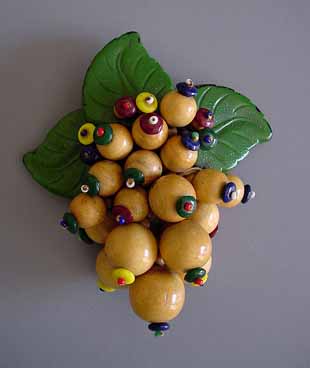
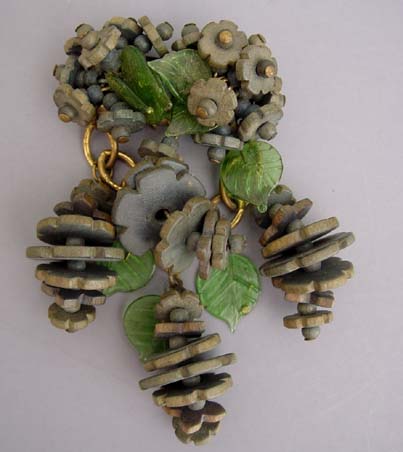
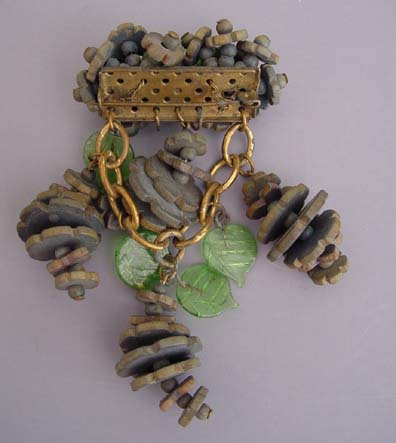
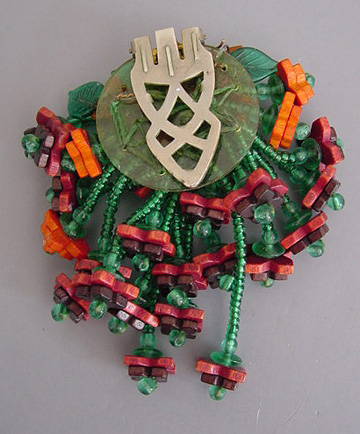
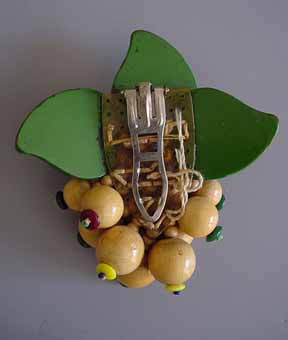
HASKELL pierced back pin on
a wooden beads pin circa 1945.
View
View
View #H31323 |
Pressed glass leaves on a wooden beads pin circa 1945. |
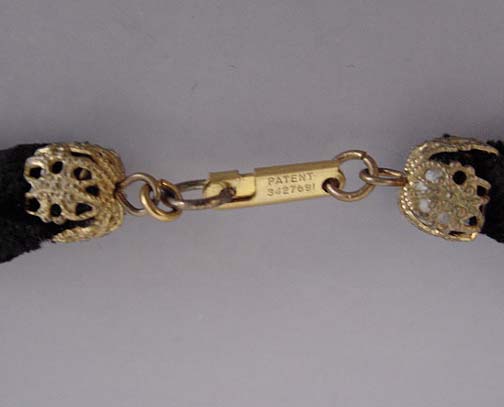
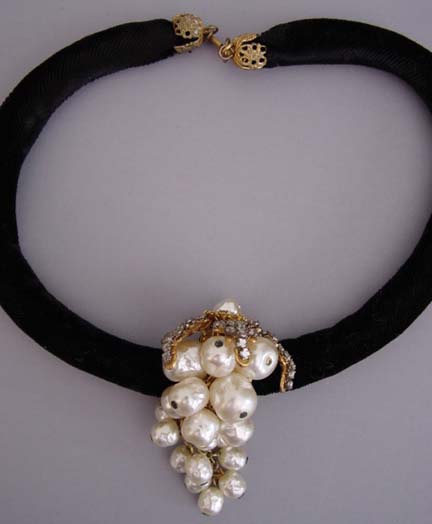
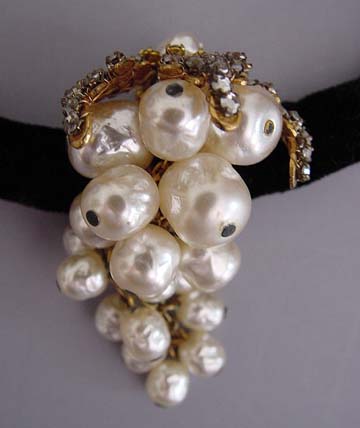
HASKELL push clasp on a artificial pearls
and rose montee pendant on black velvet neck band, 14-1/2" with 2-1/4" front
drop, catch patent #3427691, circa 1969.
View
View #H51089 |
|
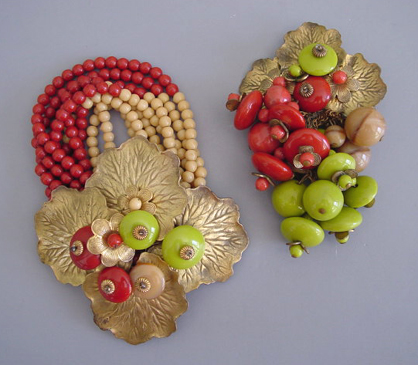
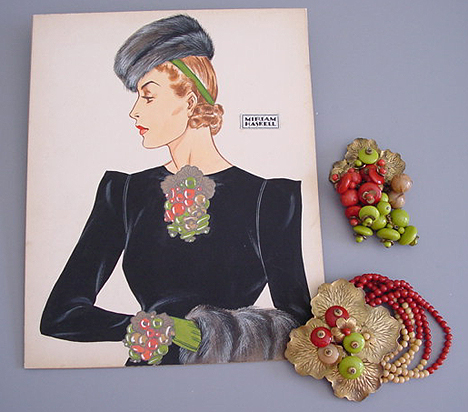
HASKELL Hess
chartreuse, burnt sienna and tan glass beads and gold tone leaves expansion
bracelet, 3-1/4" front, and matching clip. #H26051 |
HASKELL Larry Austin
original watercolor advertising illustration for Haskell bracelet and clip,
numbered "815" on back in pencil, 8" by 10".
View #H26053 |
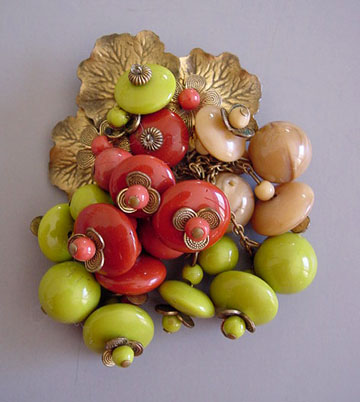
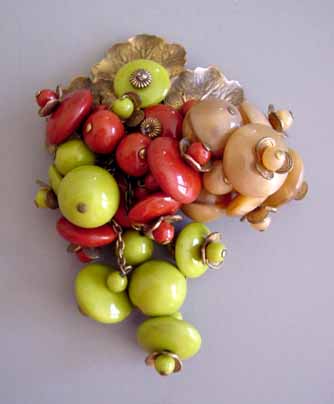
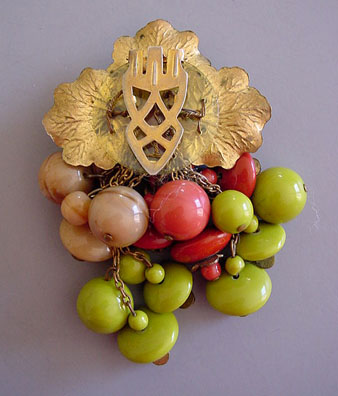
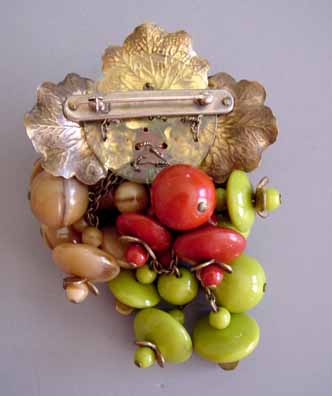
HASKELL early
unsigned Frank Hess design from the 1940’s. This 4" dress clip is made up of
chartreuse, coral and tan
glass beads. View
#H23939
And this
HASKELL is a
brooch, not a clip.
View #H21112 |
|
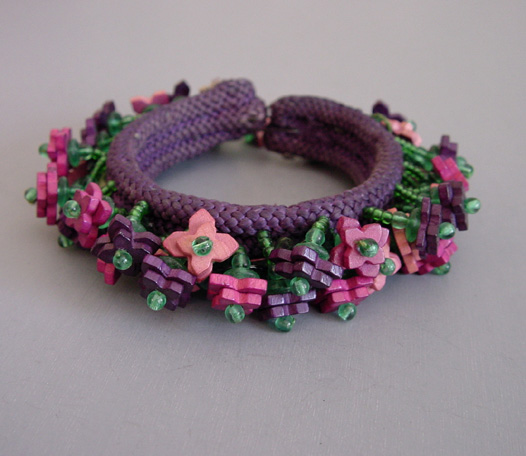
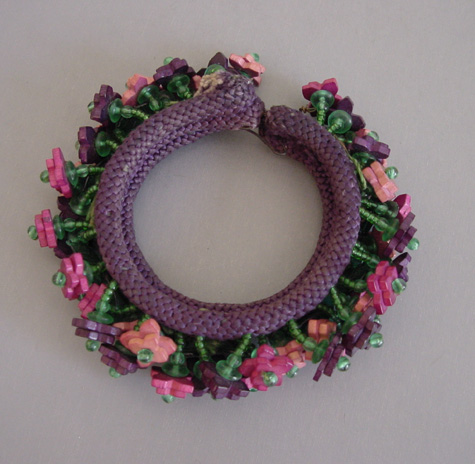
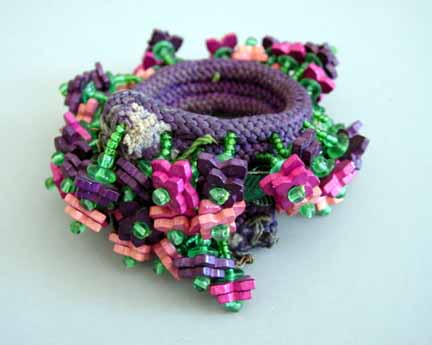
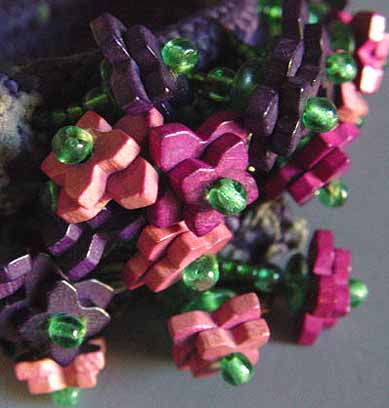
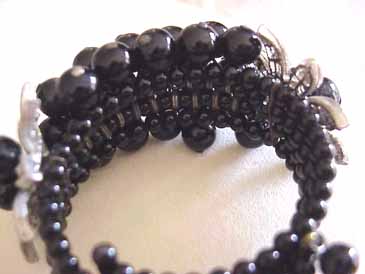
HASKELL early Hess wooden beads and glass seed beads coil bracelet, WWII
era.
#H22088 |
View
showing the woven covered coil construction of the bracelet. Closer views of beads.
View
View |
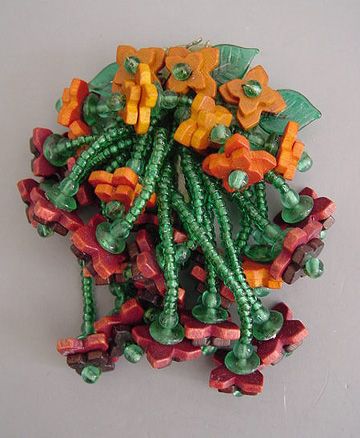
HASKELL Hess early unsigned
dress clip with wood florets and green glass beads, 3".
View #H26700 |
|
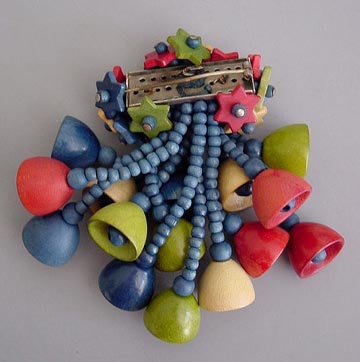
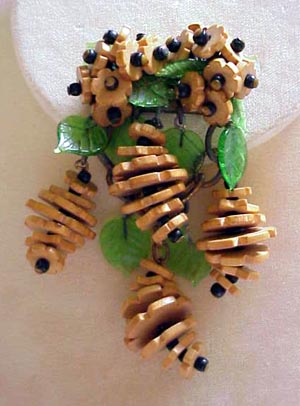
HASKELL wooden
beaded 3" long pin. Clips and pins in this series came in various colors and designs,
circa 1935-40. (Seen in Christie Romero’s "Warman’s Jewelry, 3rd Ed,
page 195.)
View
#H19700 |
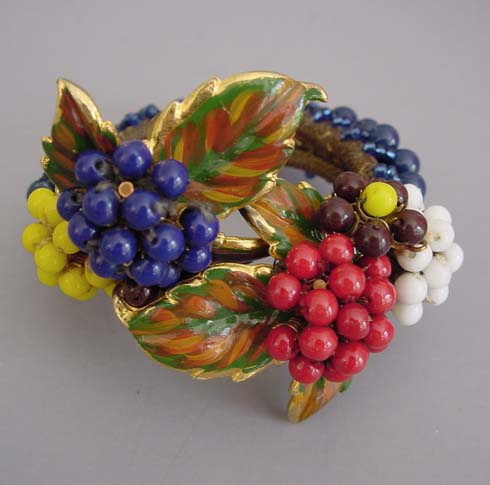
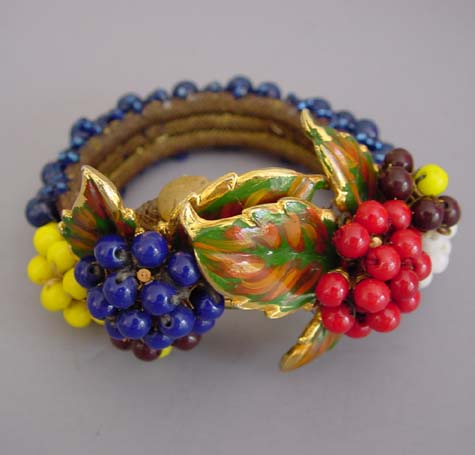
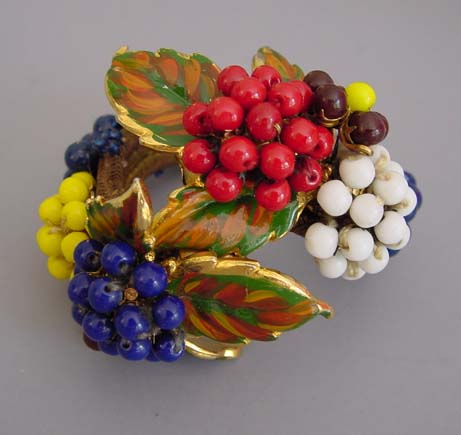
HASKELL early unsigned
multi-colored glass opaque beads and painted metal leaves bracelet, 6-1/2".
View
View #H24186 |
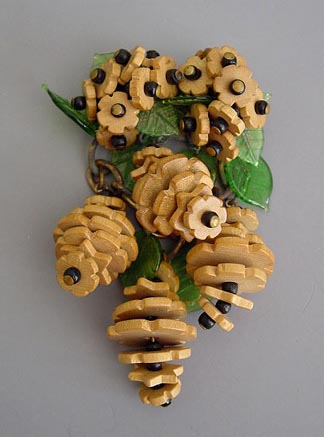
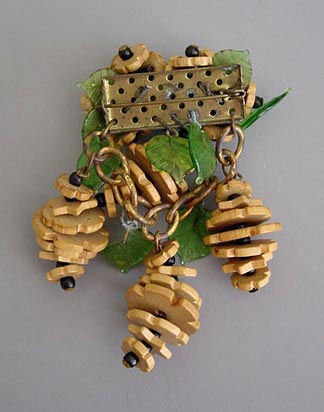
HASKELL
early unsigned wooden beads "pinecones" pin, circa 1935-40, 3-1/2".
(Seen in Christie Romero’s "Warman’s Jewelry, 3rd Ed, page 195.)
View
View #H19832 |
|
HASKELL original gouache art
work, probably by Larry Austin. Advertising a Miriam Haskell stick coral
coil bracelet and clip, numbered #1067 on the back, 8" by 10".
#H31940
|
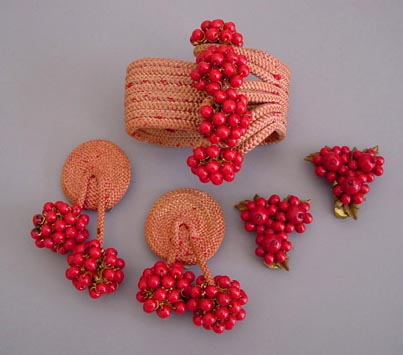
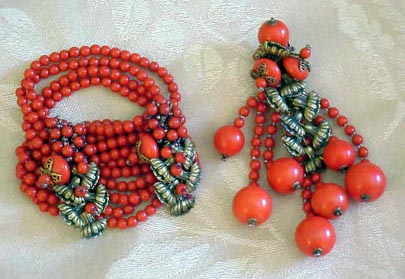
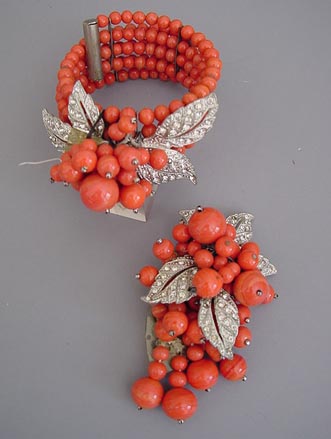
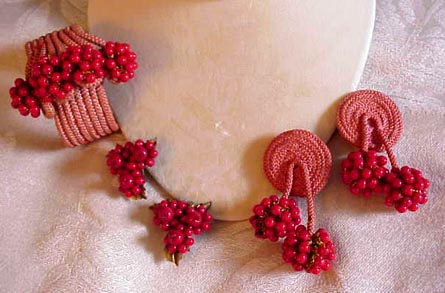
HASKELL early unsigned red woven fabric jewelry: bracelet
and two sets of dress clips.
View
View #H19820 |
CLIPS
Back |
|
|
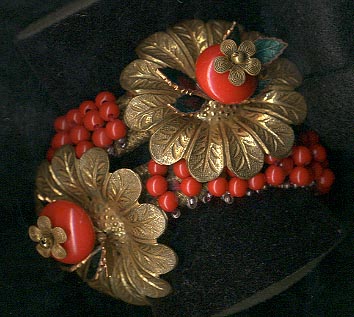
This fabulous set comprised of a bracelet and two dress clips made of red
bead clusters attached to silk cord, and two beaded clips. Similar pieces can be seen in Cera on
pages 32 and 70, and in Haskell ads from the time. |
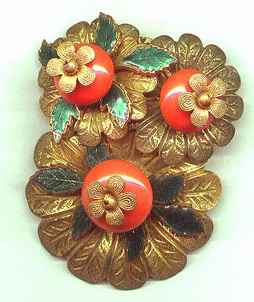
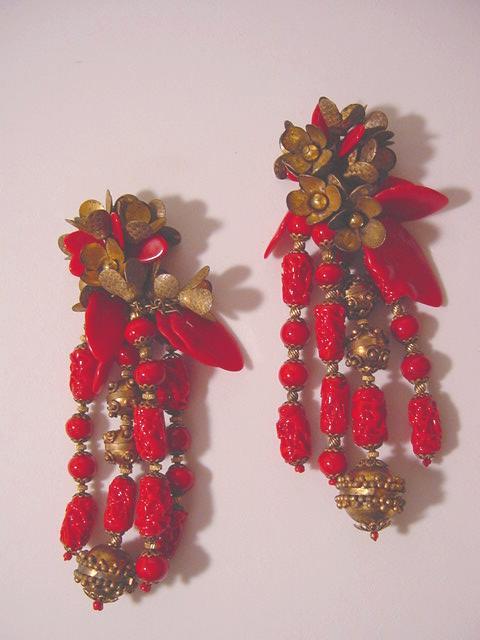
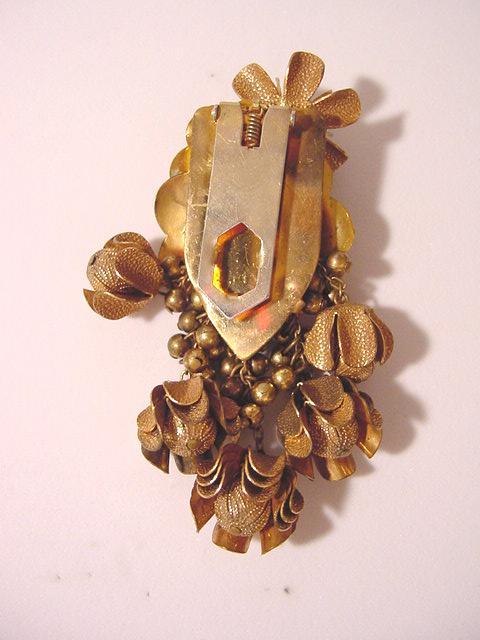
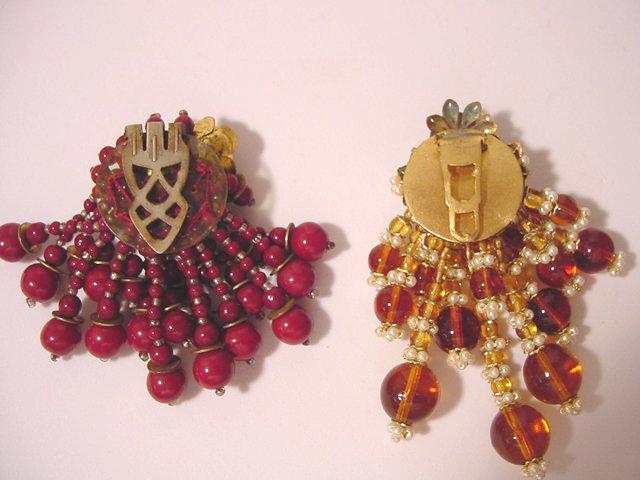
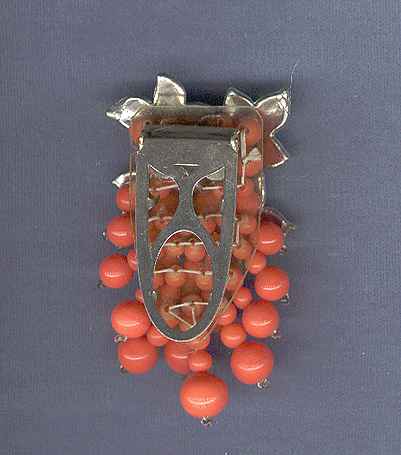
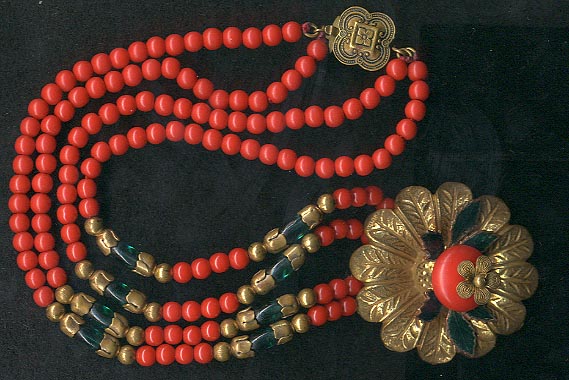
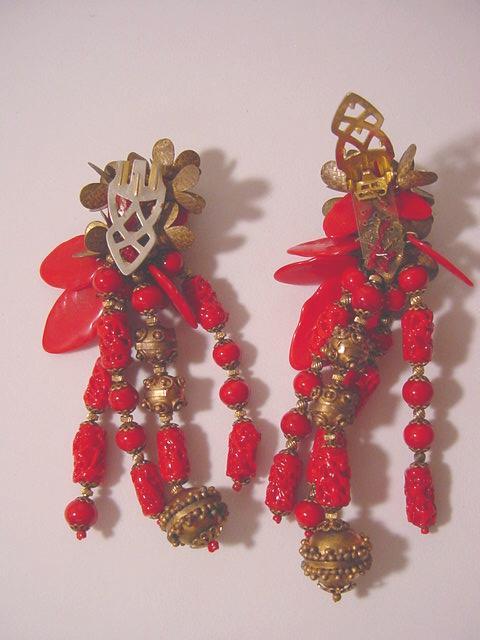
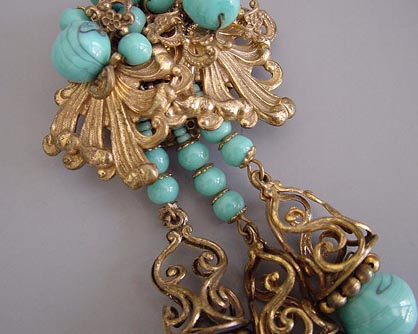
Two Chinese red dress clips with carved glass beads, brass
flowers and ornate, dangling brass spheres, Haskell looking but not
Haskell.
|
|
"Political events also influenced designers. Out of sympathy for
the Chinese and Greek people who were fighting Japan and Italy…they
turned to those antique cultures for inspiration." Cera, The
Jewels of Miriam Haskell, p 29.
|
|
HASKELL early unsigned expansion bracelet and pair of matching dress
clips. #H22609 |
HASKELL
Larry Austin original watercolor advertising illustration for Haskell white
beads bracelet and clip, "right" penciled on back, 8" x 10".
#H27269 |
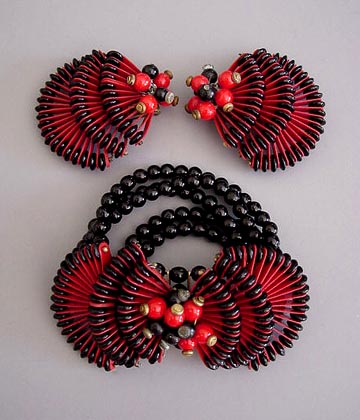
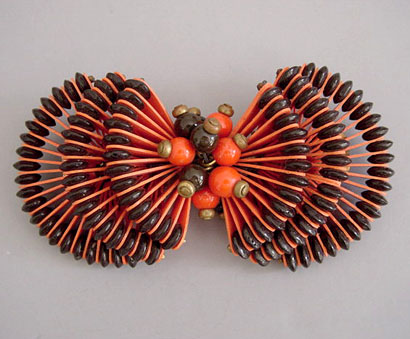
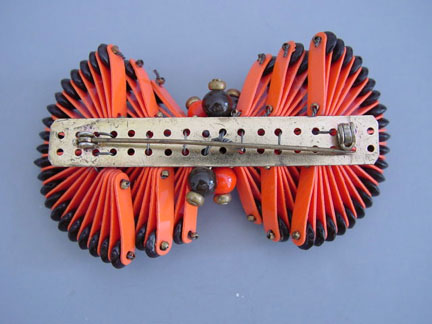
HASKELL early unsigned
orange-red and black pin with glass beads center, circa 1940, 3-1/3".
View #H27221 |
|
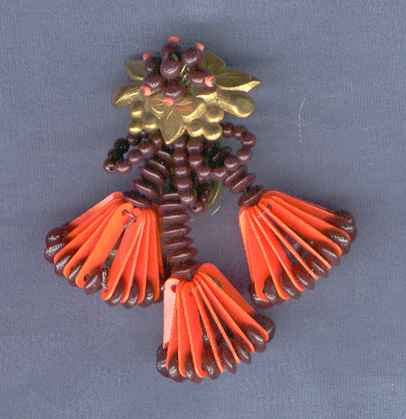
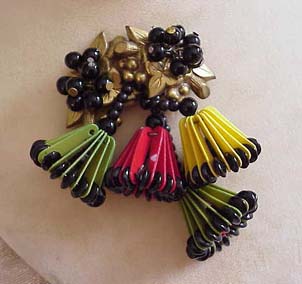
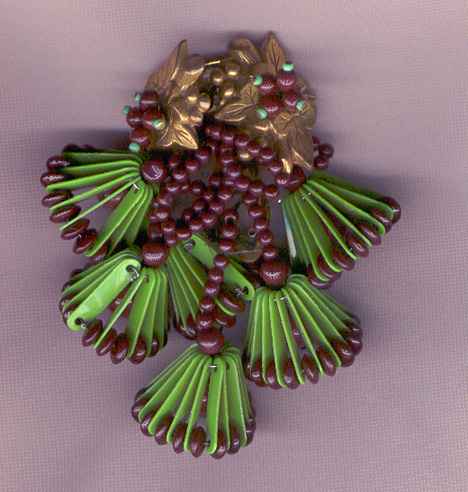
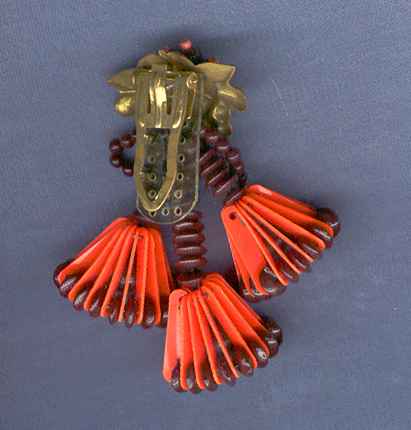
"Typical of the pieces designed by Frank Hess and produced during
the war are the dangling clips with a minimum amount of metal stampings
and non-traditional ornaments on a base of transparent plastic, which has
become yellow with age." Cera, The Jewels of Miriam Haskell, p 31.
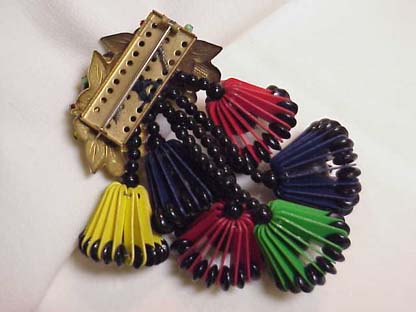
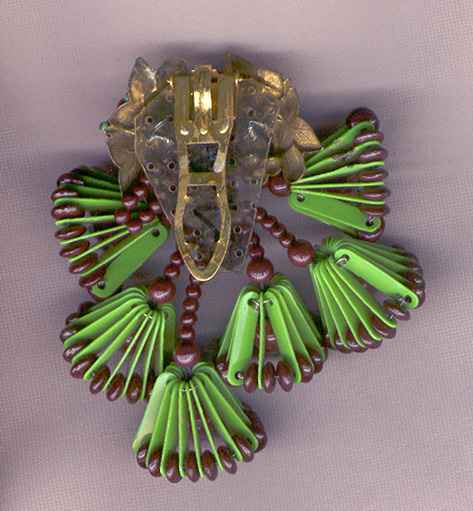
All three of these are what Cathy Gordon calls
"lampshade clips", and they demonstrate the use of alternative
materials when white metal was in short supply during the years of World
War II.
It certainly appears, after looking at so many of
these clip backs, that there is a trend. We already knew that the
plastic backs were used during the war years, but we’ve noticed several
different clips being used also. Some are inexpensive and others
are more like what we consider the "standard" clip which is of a much
better construction. Could the inexpensive clips have come
later as more metal was needed for the war effort? The
"lampshades" all have the inexpensive clip and are made out of plastic as well. In fact the
top pieces (the brass flowers with beads) are a very thin lightweight
metal.
|
|
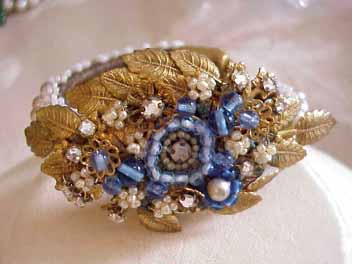
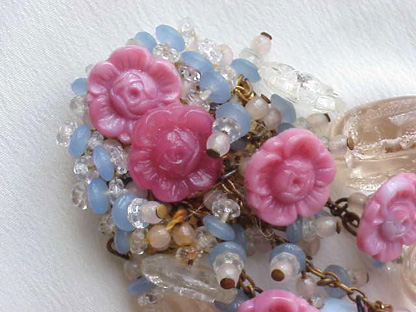
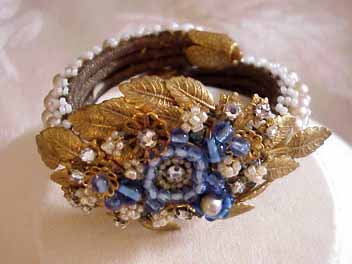
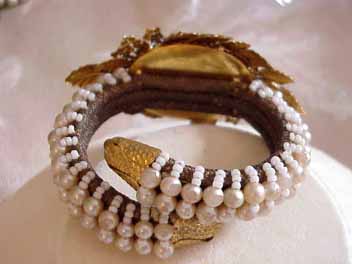
HASKELL
early unsigned coil bracelet circa 1940. Blue glass beads and
artificial pearls backed by layered gold tone textured leaves. (Purchased
directly from Haskell Jewels’ collection of early Frank Hess pieces.) View
View #H19193 |
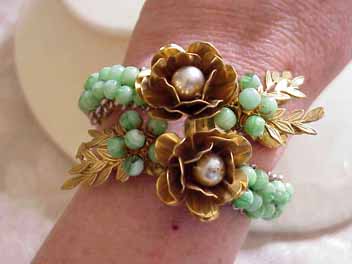
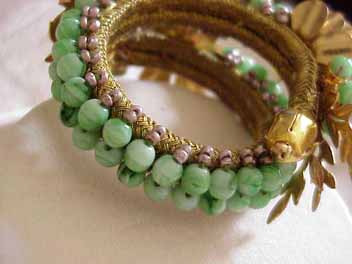
HASKELL
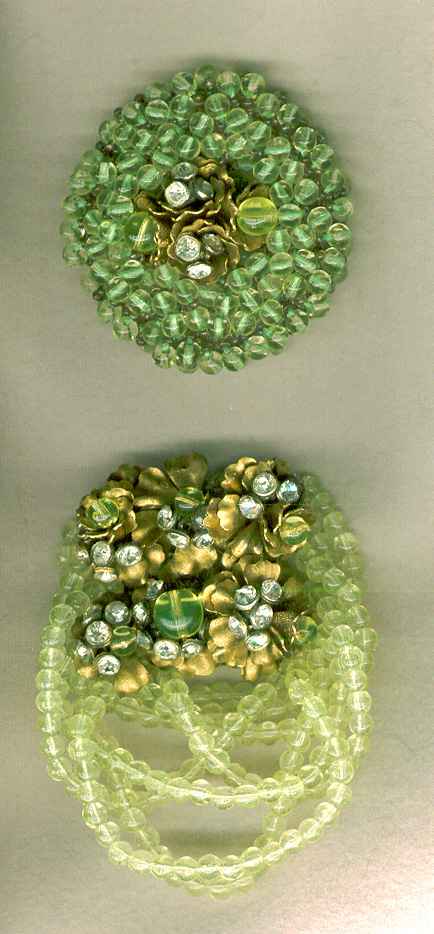
early unsigned coil bracelet circa 1940. Pastel green opaque glass beads,
artificial pearls and three-dimensional gold tone flowers and
leaves. (Purchased directly from Haskell Jewels’ collection of early
Frank Hess
pieces.) View
#H19581 |
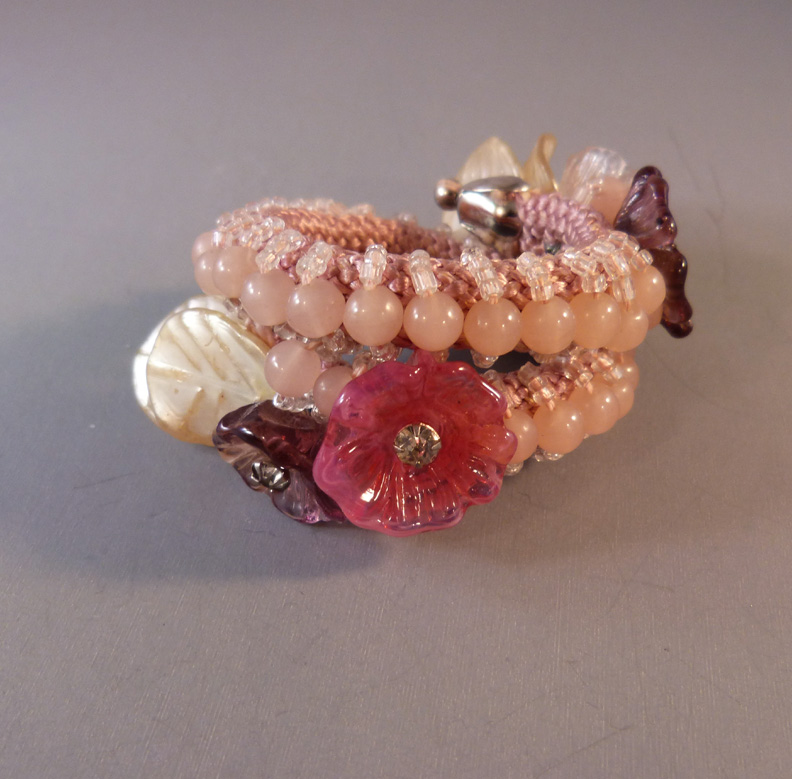
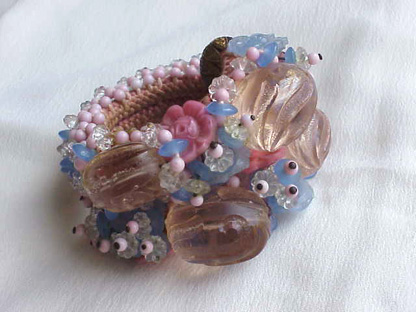
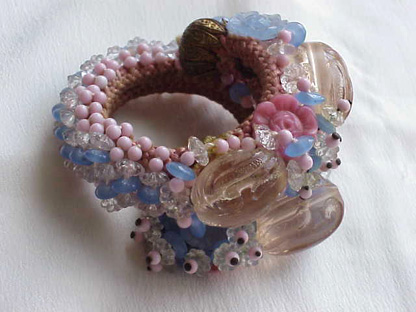
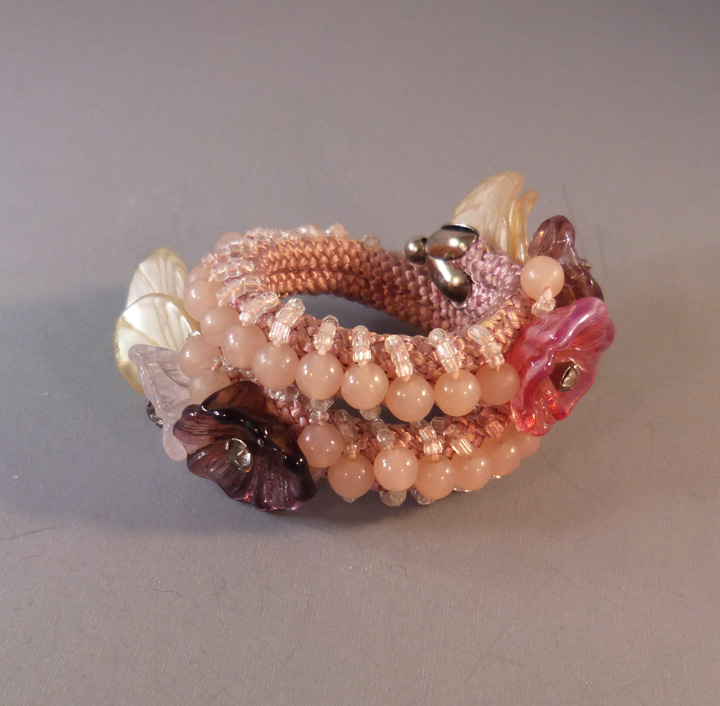
HASKELL
early unsigned coil bracelet circa 1940. Pastel pink and purple glass
flowers, artificial pearlized leaves and rhinestones. (Purchased
directly from Haskell Jewels’ collection of early Frank Hess pieces.) View
#H19583 |
|
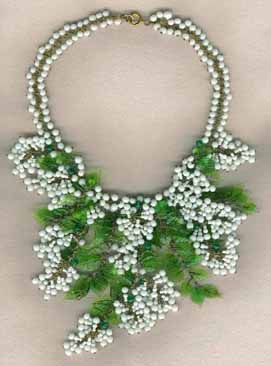
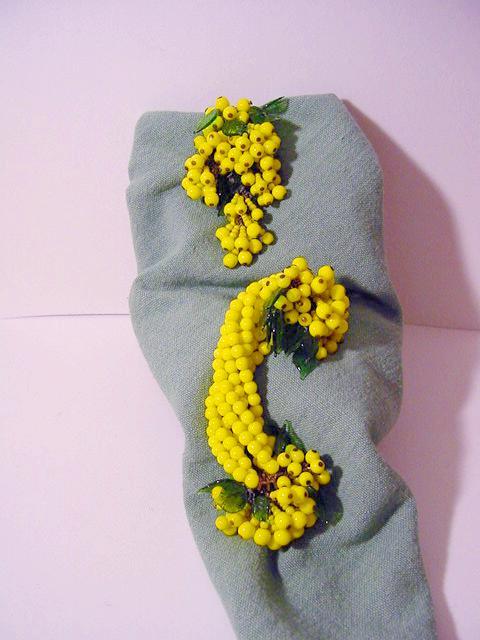
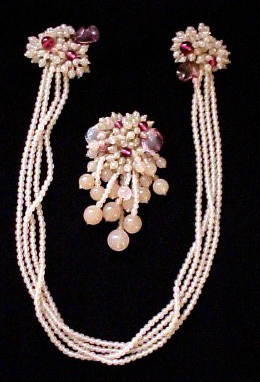
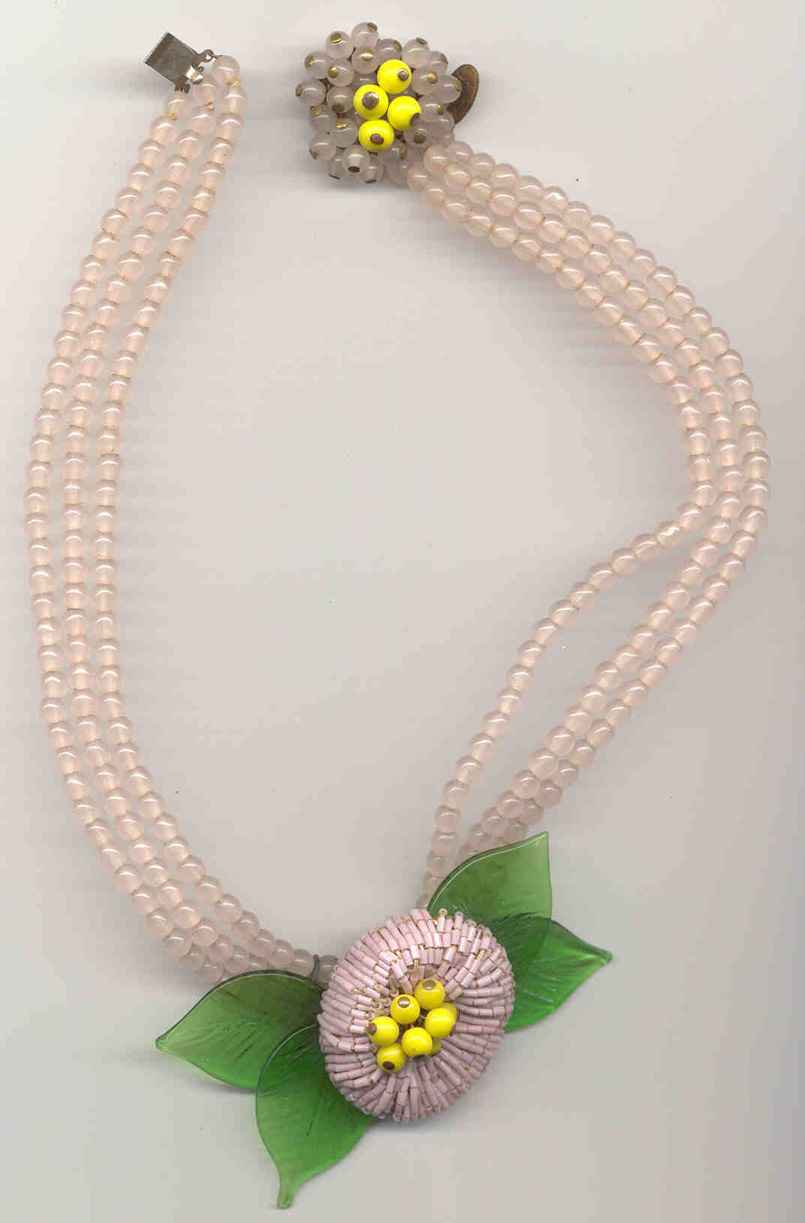
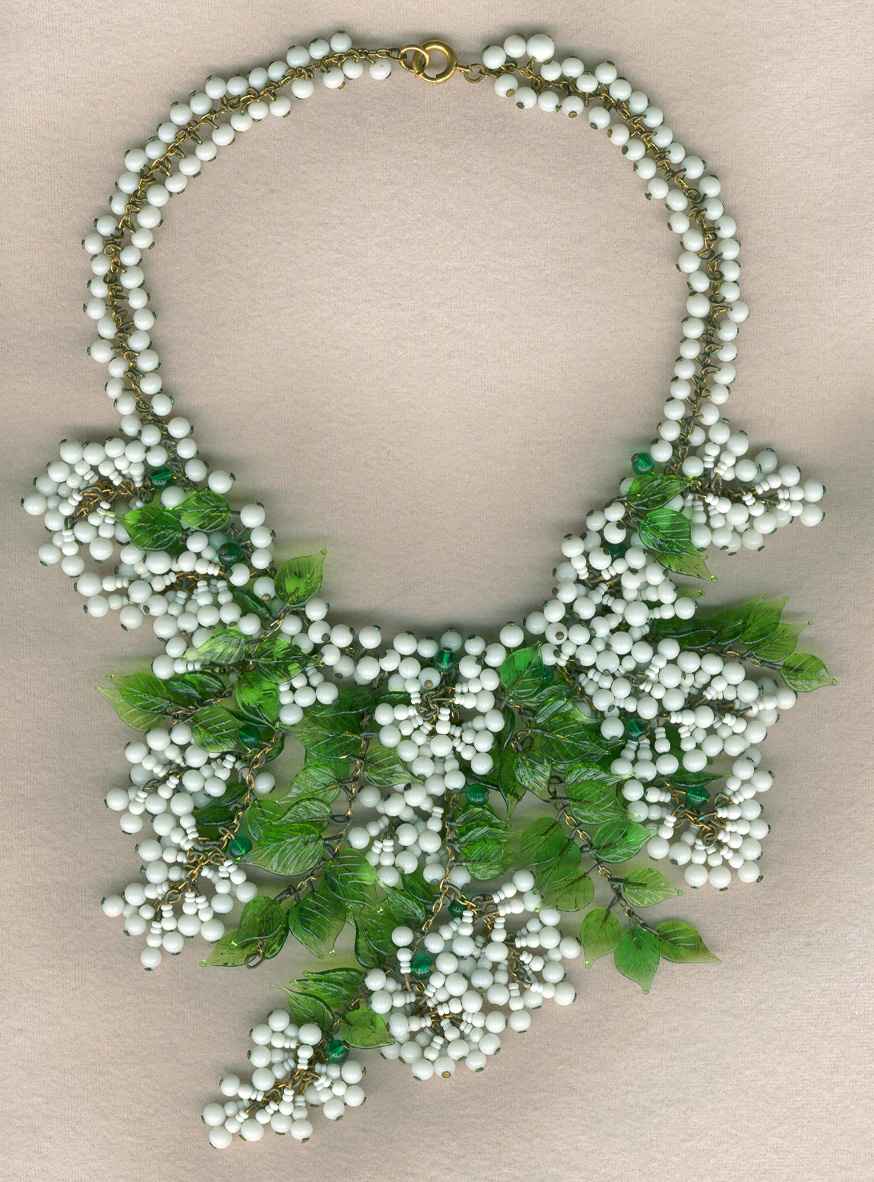
HASKELL lush
unsigned necklace with white glass beads
and green glass leaves has the same construction as the yellow set beside
it. Necklace
|
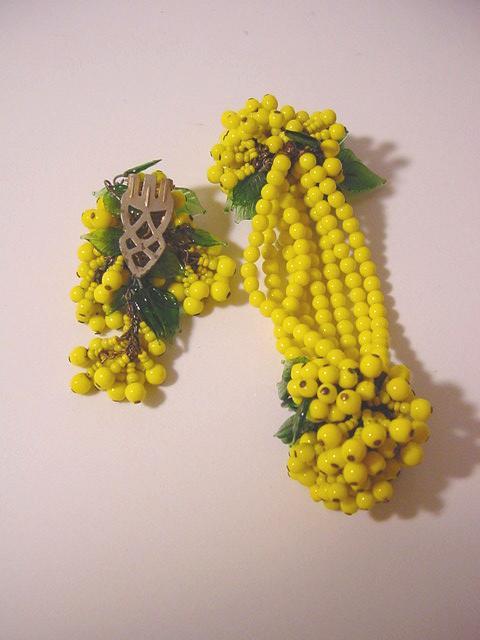
HASKELL classic
style is shown in this brilliant yellow clip and
bracelet–differing sizes of beads and delicate paté de verre glass leaves.
Back |
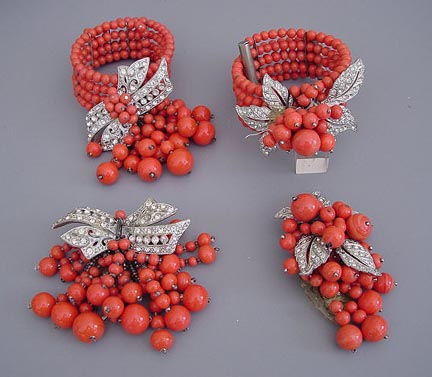
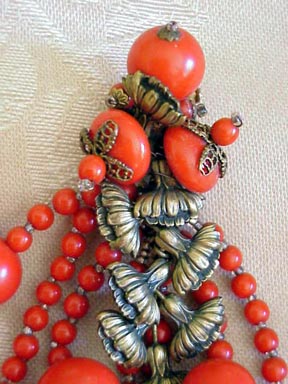
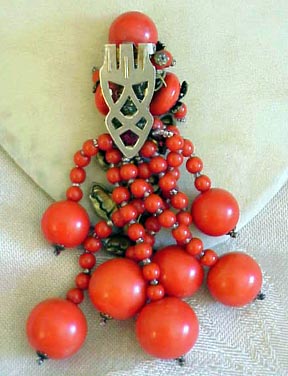
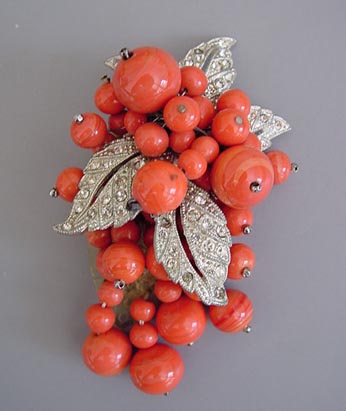
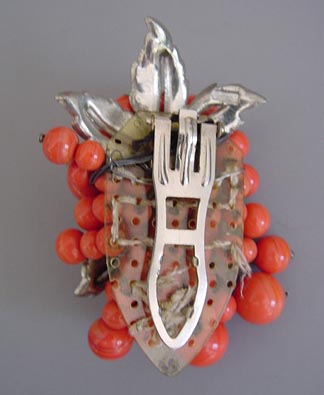
HASKELL
early unsigned coral colored opaque glass beads and metal floral findings.
Note the typical Haskell "flattened" beads with brass
floral end-caps.
The bracelet is strung on elastic. The dress clip is 4".
View
View #H19941 |
|
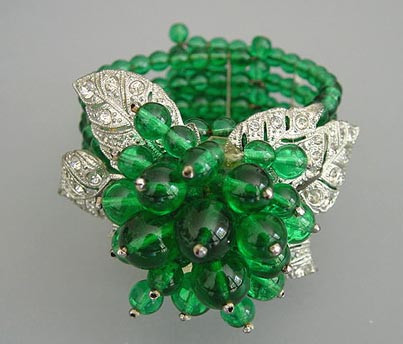
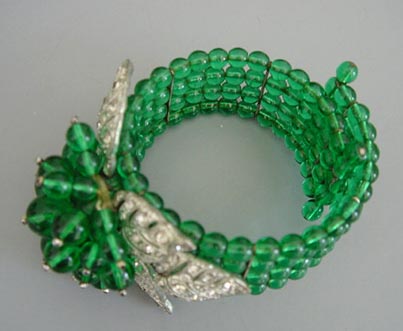
HASKELL early unsigned transparent green glass beads coil bracelet,
2-1/3" front, 1" wide. View
#H26800
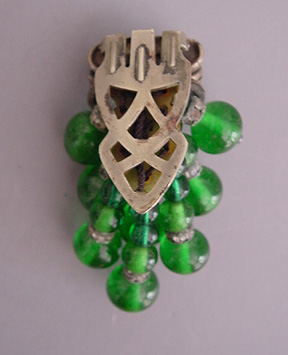
HASKELL Hess early
unsigned green glass bead dress clip with clear rhinestone accents, 2-1/4".
View #H26743 |
HASKELL early unsigned
blue glass beads dress clip with clear rhinestone leaves, 3-1/2".
View #H26799 |
HASKELL early unsigned
aqua glass beads and rhinestone leaves coil bracelet, 1-3/4" front.
(Seen in Christie Romero’s "Warman’s Jewelry, 3rd Ed, page 190.)
View
Bracelet
View
View View
#H22610
HASKELL early unsigned aqua glass bead dress clip with rhinestone
leaves, 2-3/4″. View
#H22888 |
|
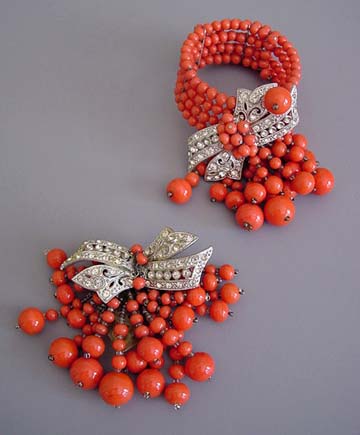
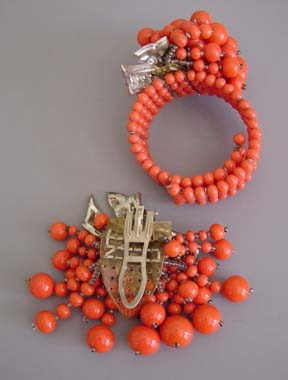
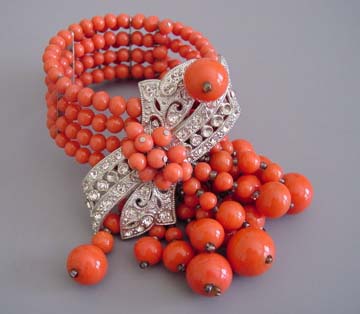
HASKELL
early unsigned orange glass bead coil bracelet (7/8" wide 3" front drop) and
2-1/2" dress clip with silver tone and clear rhinestones ribbon motif.
View
View
View #H20469 |
|
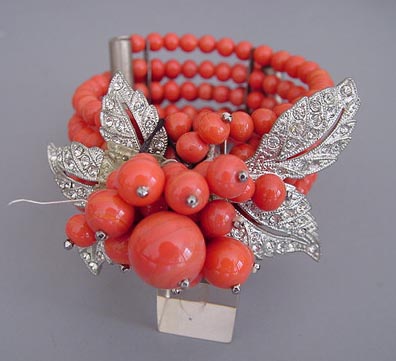
HASKELL early
unsigned orange glass bead coil bracelet (7/8" wide 3-1/2" wide front) and
2-1/2" dress clip with silver pot metal and clear rhinestones leaf motif.
View
View
View #H24003 |
A combination of glass beads with pot metal and rhinestone
leaves give this clip a lush look, and it again shows the fine finishing
detail of a tiny bead at each tip. Next to the clip is the matching
bracelet.
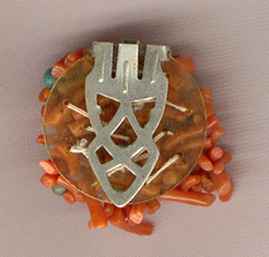
Coral glass beads and gold tone florets create a wreath clip in a
pleasingly asymmetrical design, with the matching bracelet to its left.
These clips and bracelets all seem to vary slightly in size and design.
There is some thought that the dress clips and bracelets using cast
metal pave leaves are not Haskell, though the style of stringing different
sized beads and ending each length with a tiny seed bead certainly looks
typical. Cera states on page 59 of The Jewels of Miriam Haskell,
"Because the use of glue was never permitted in making Miriam Haskell
jewellery, rhinestones were used as little as possible."
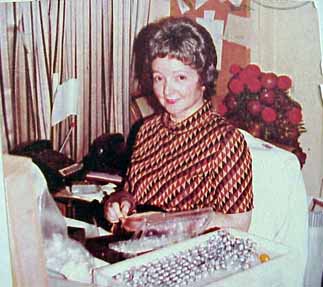
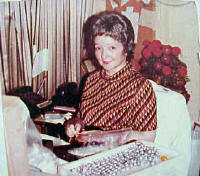
Conversely, Bertl Groll, who was
assistant to Frank Hess, identified
these as Haskell pieces. Bertl was also assistant to several
of the later Haskell designers. The photo below shows Bertl
in the 1970’s, during the time when Larry Vrba was the head designer,
sitting at her desk at Haskell. Notice the tray of Haskell artificial
pearls next to her left hand.
|
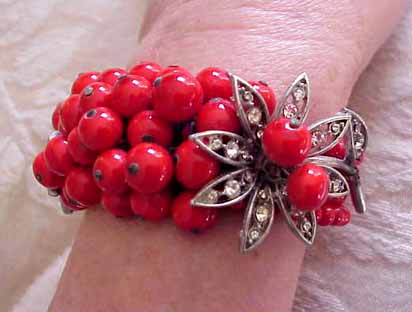
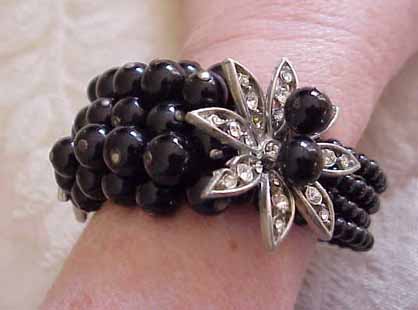
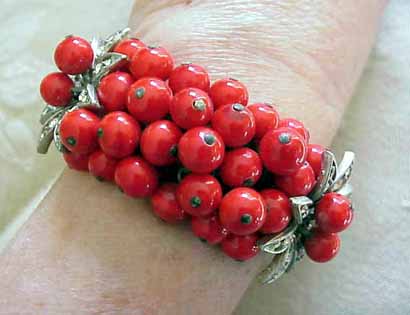
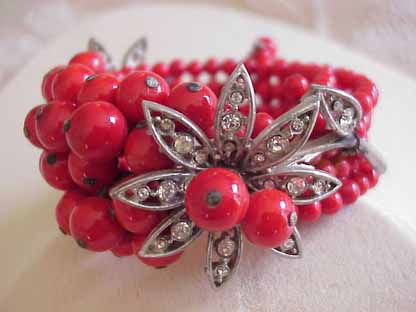
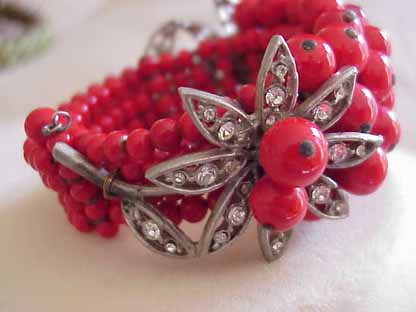
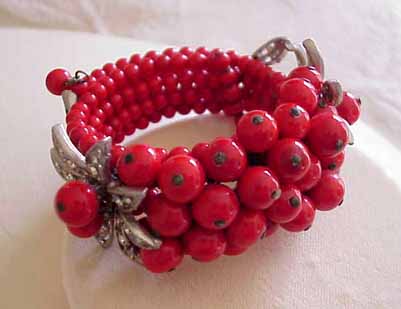
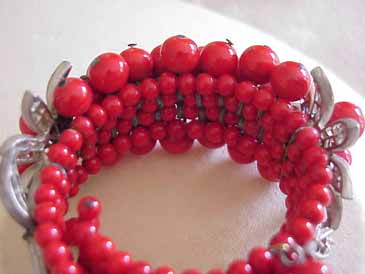
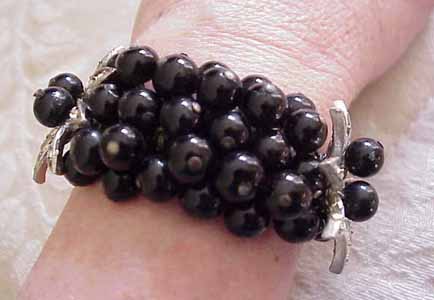
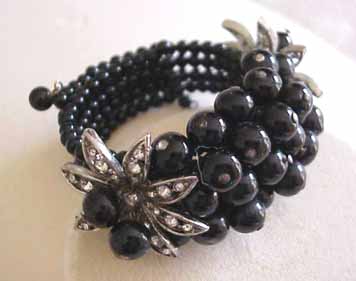
Two matching bracelets, one in red and the other in black.
Note the difference between the rhinestone flowers in these compared to
the green bracelet and clip on the right.
While the red and black bracelets may
or may
not be Haskell pieces, the combination of
multiple-sized glass beads with pot
metal and rhinestone leaf and flower findings makes lovely jeweled
bouquets.
|
|
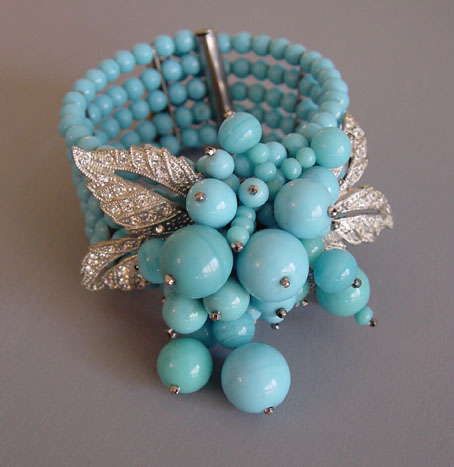
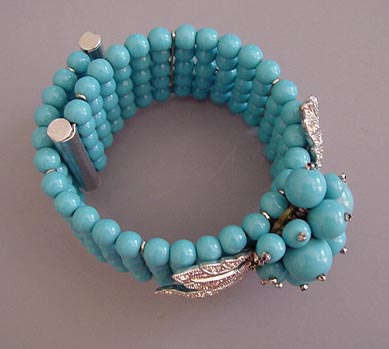
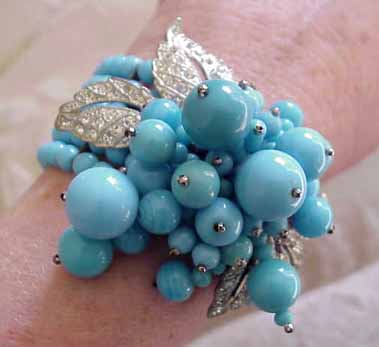
HASKELL early
unsigned clip of aqua glass beads and lovely gold tone findings, 4".
View #H19736 |
HASKELL early unsigned aqua faceted crystal beaded 2-1/4" round dress clip
with 2" beads drop and 7" "button" fastening bracelet.
View
View
View
#H19738 |
HASKELL attributed early
unsigned 4" dress clip in gold tone petals and beads with aqua glass beads
in three different shapes.
View #H24809 |
|
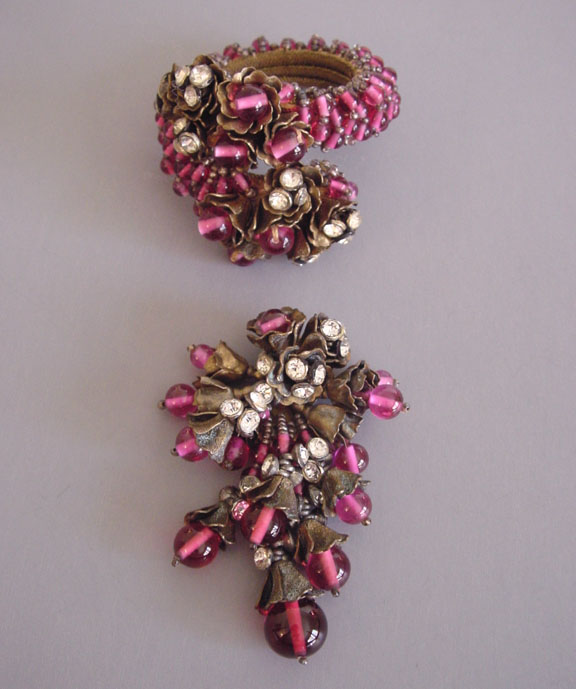
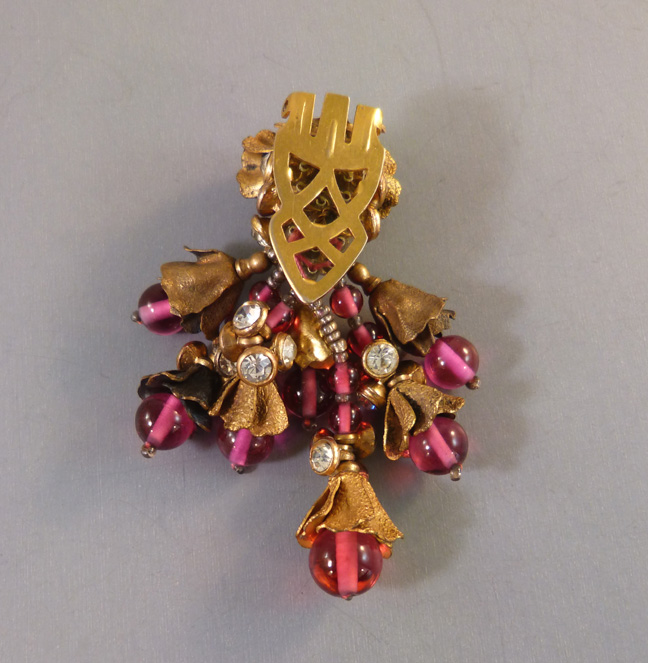
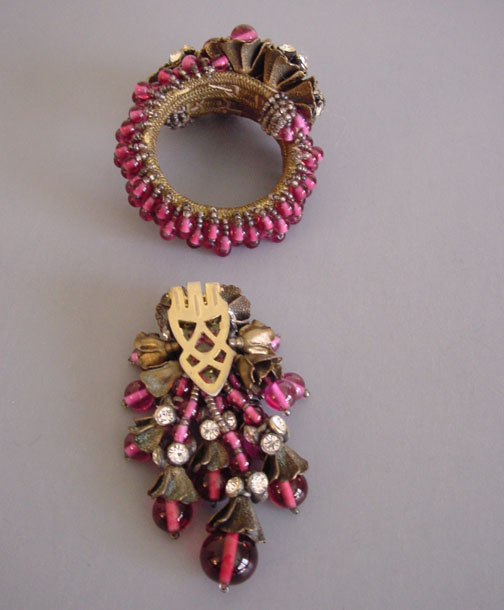
HASKELL early
unsigned cranberry glass beads and clear rhinestones coil bracelet and
3-1/3" dress clip. View #H24394 |
CLIP and
bracelet of yellow glass beads and clear rhinestones. |
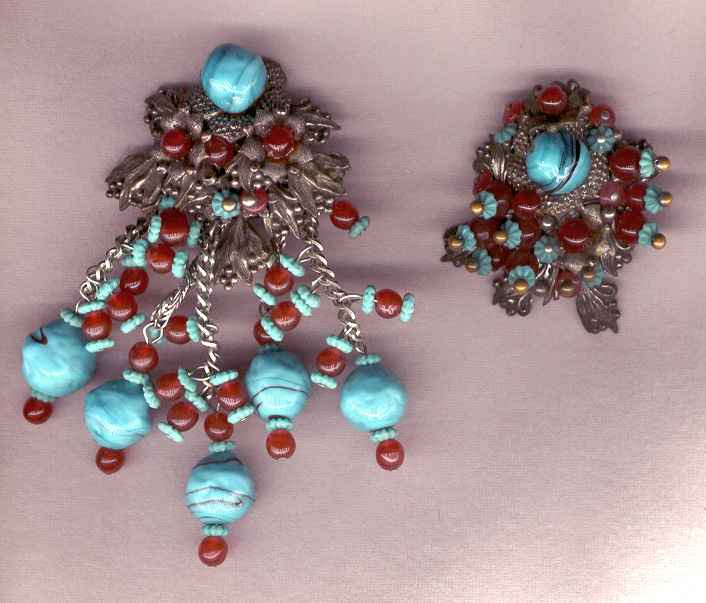
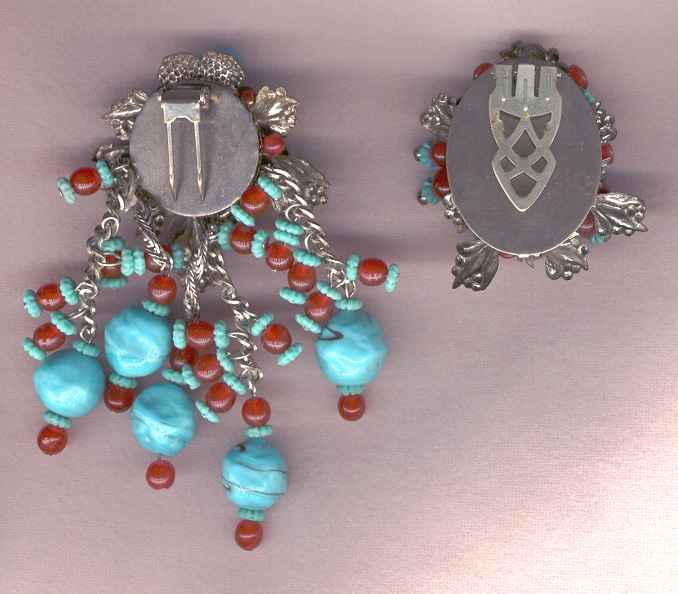
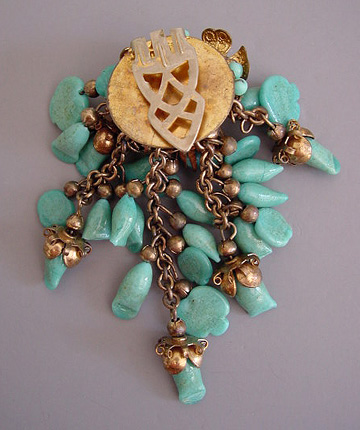
HASKELL
aqua and red glass bead clips and clip
backs. A matching set of clips (fur and dress) with silver
metal, floral designs, irregular glass beads imitating turquoise and
cranberry and turquoise paté de verre beads. There is also a matching necklace for these
clips.
|
|
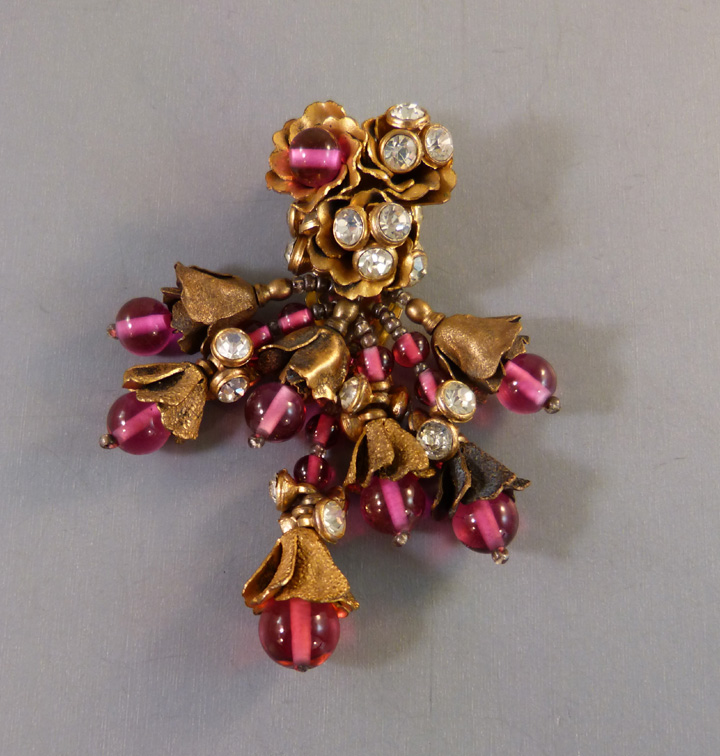
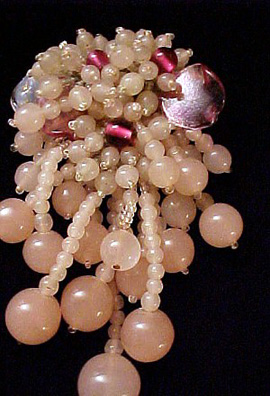
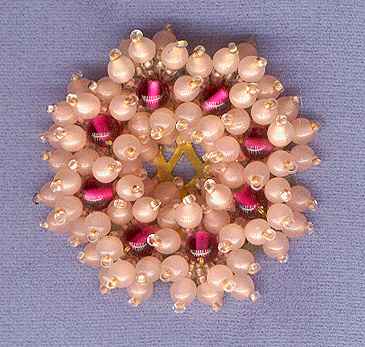
Several versions of pink and "pomegranate" glass beads–cascading,
as a sautoir and in a starburst effect.
|
|
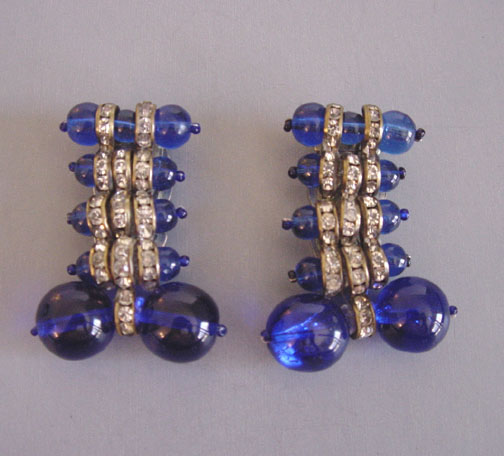
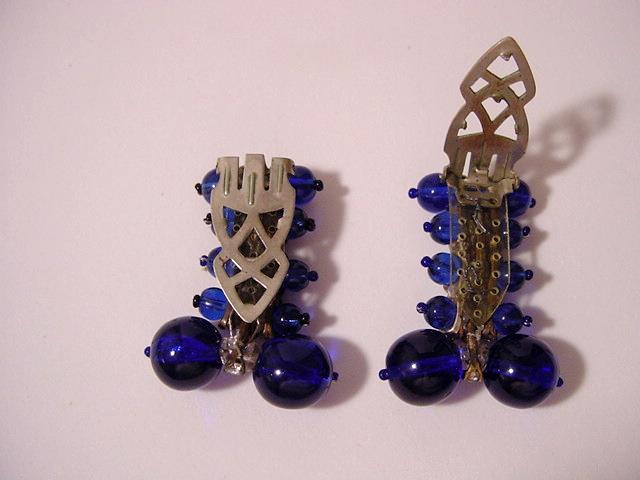
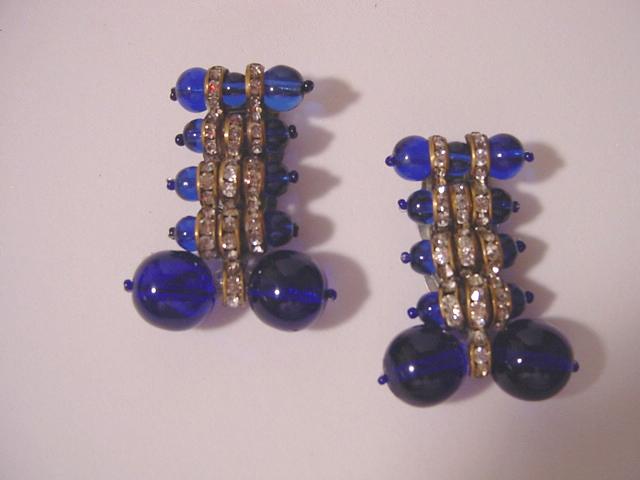
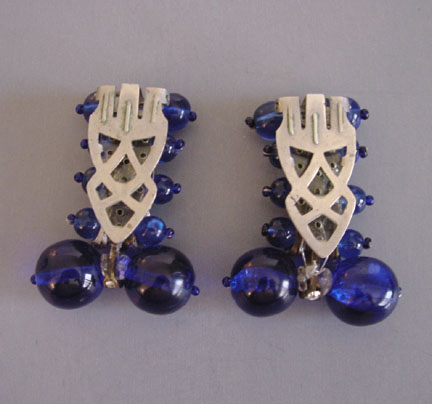
HASKELL unsigned cobalt blue glass bead clips with clear rhinestone accents.
View . Here is an
AD showing these Haskell clips as a part of a set made in traditional Haskell
faux pearls. However, some feel that these clips were not Haskell,
but French. View. #19940 |
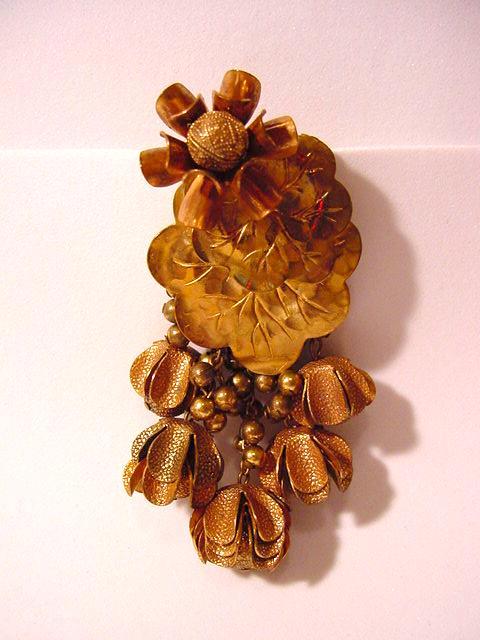
A very feminine dress clip made completely of metal,
attribution probably Hess Haskell. |
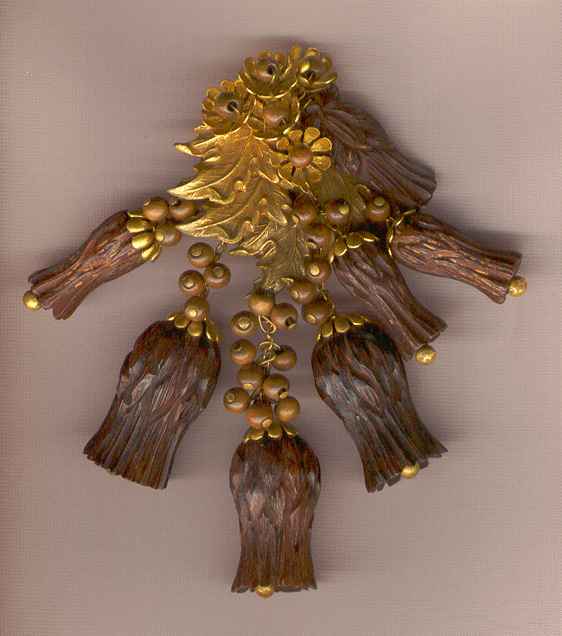
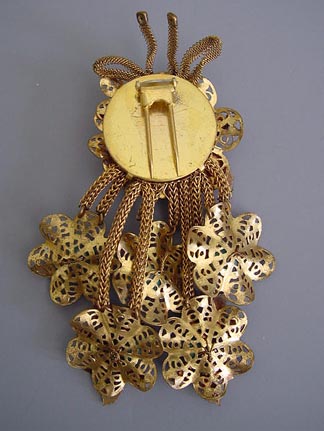
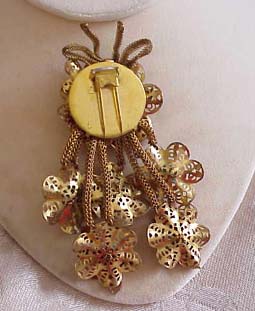
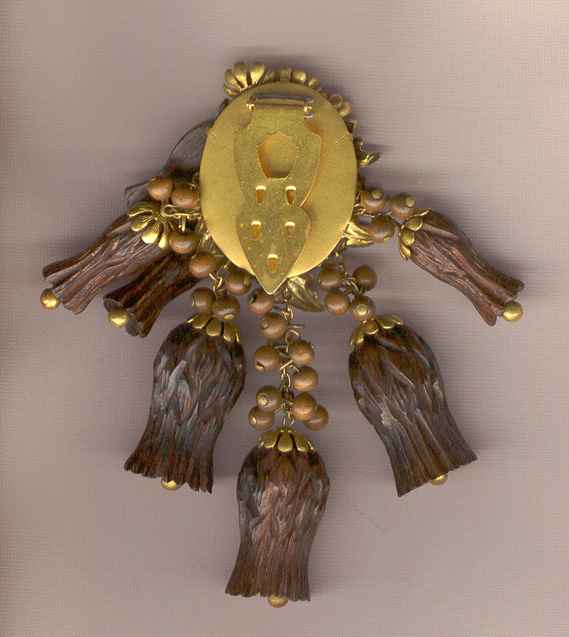
A wonderful clip of gilded brass leaves and flowers combined with
dangling, carved wood flowers and wood beads circa 1938-1939. You can see
a similar clip using wood carved as walnuts on page 75 of Cera, The
Jewels of Miriam Haskell.
|
|
Some authorities think this
style is French and not a Haskell although there is an old Haskell ad
that illustrates designs very similar to this. Update 2009: we now have
enough documentation to attribute these as Hess Haskell. |
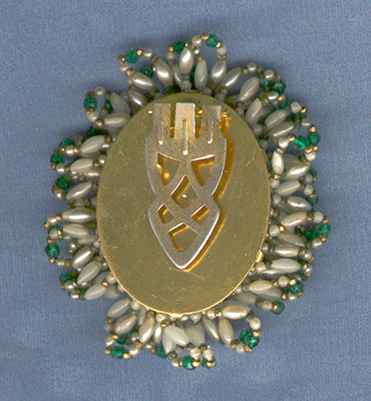
Both the back and the front show typical Haskell construction,
but attribution of this piece is uncertain. |
In the tradition of the Art
Nouveau artists before her, Haskell used many unusual materials during the
war years when the normal jewelry making materials were in short supply.
One favorite is the necklace made of pine cone petals! Pods, wood, plastic
and sea shells were all used in Haskell jewelry.
|
|
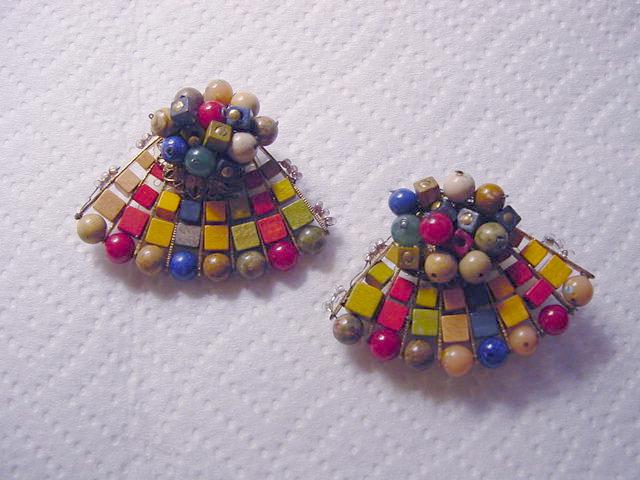
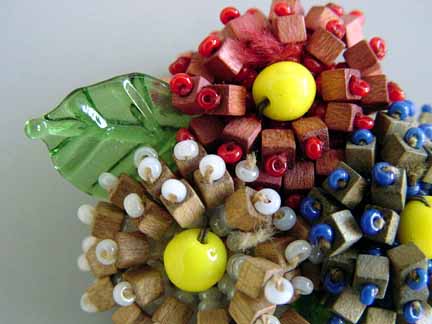
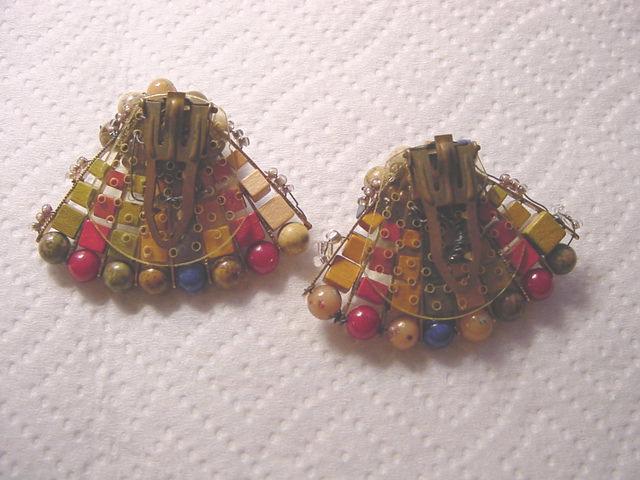
One of the most unusual clips we have ever seen. It is
quite small, but the use of color, round glass beads, square wood beads
and pressed glass leaves is an artistic wonder. The beads are Czech
looking, but the poured glass leaves and overall design look like Haskell.
Clip
View
View clip back #H21874 |
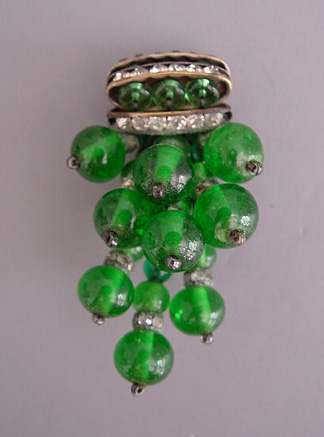
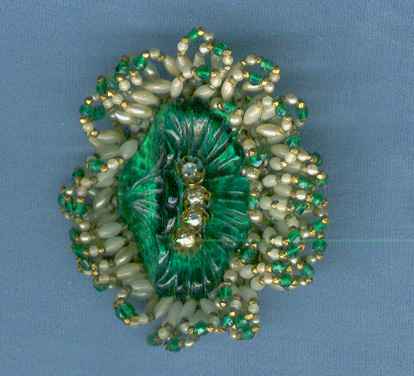
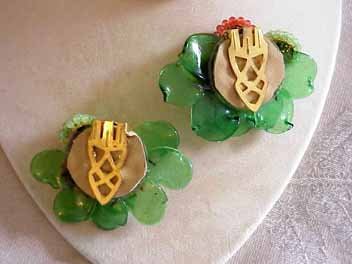
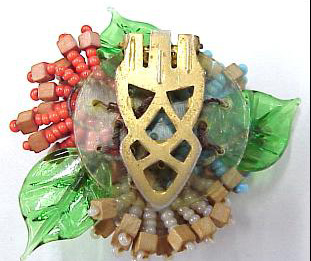
The large green glass flower, sometimes called "the tulip",
was used in this clip and is also seen in other
colors in later Haskell brooches and necklaces. CLIP
Back
|
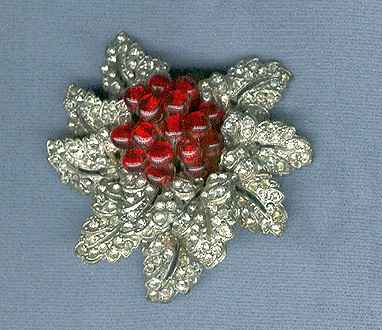
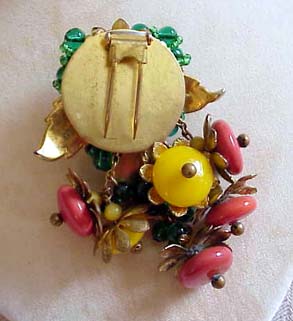
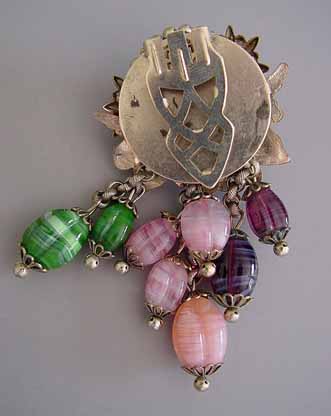
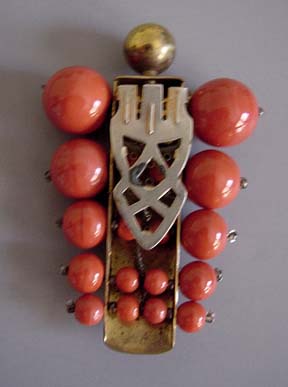
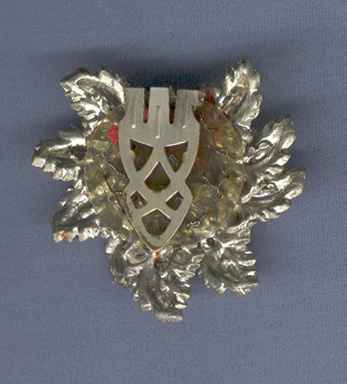
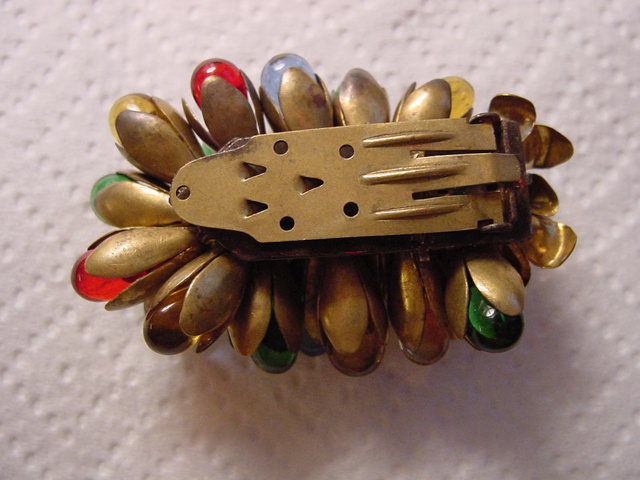
Red and looking like pomegranate seeds, this clip is nested into cast
silver tone leaves, a lush combination. Bertl identifies this
as a Haskell. CLIP
Back |
|
CLIP Back |
CLIP
Back |
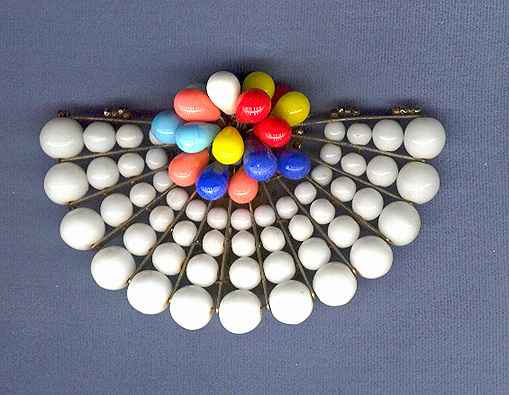
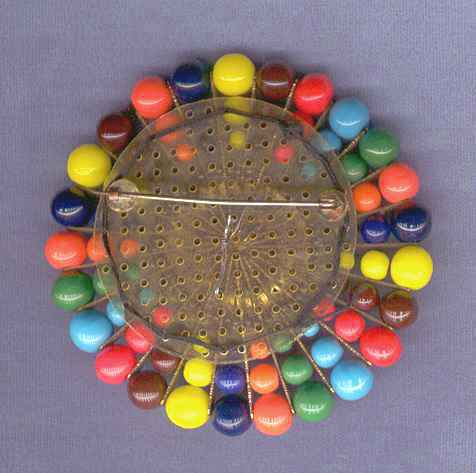
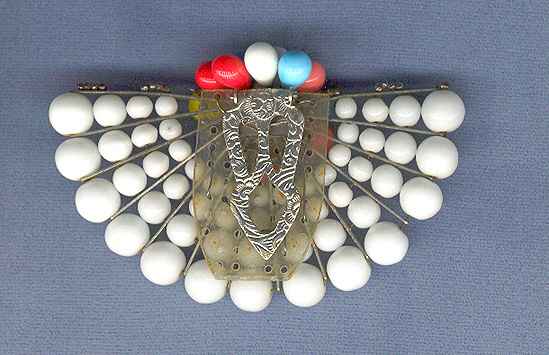
White and crayon colors beaded clip ….and clip back
Bertyl Groll, long time Haskell sample maker who was there during the
Hess era, said that she does not think this is a Haskell. |
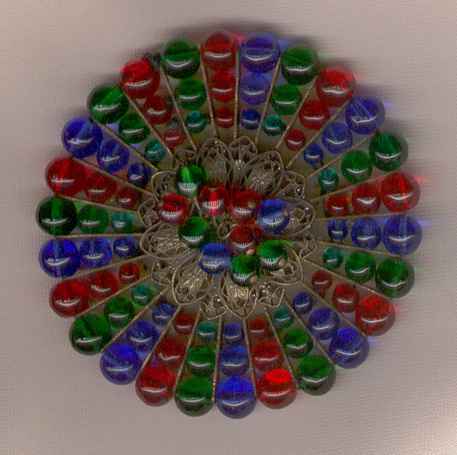
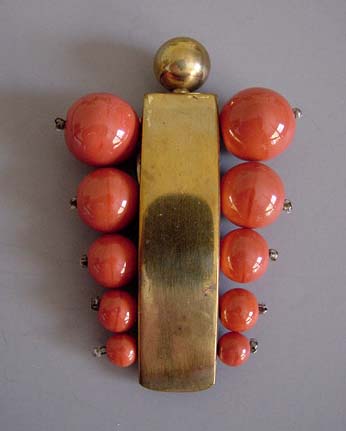
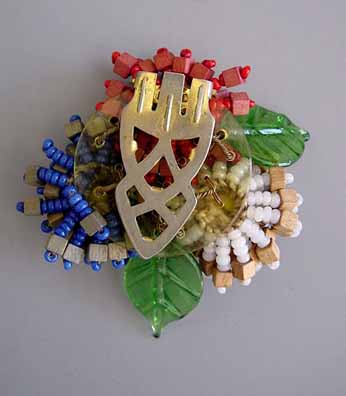
The two brooches on the left are said
by the owner to be Haskell prototype brooches.
They have similar
pierced celluloid backs from the war years. Notice also the similarity to
the crayon colored dress clip shown on the right, not only in color,
but also in the metal spacers that separate the beads.
|
Czech, , French, Haskell or ???
|
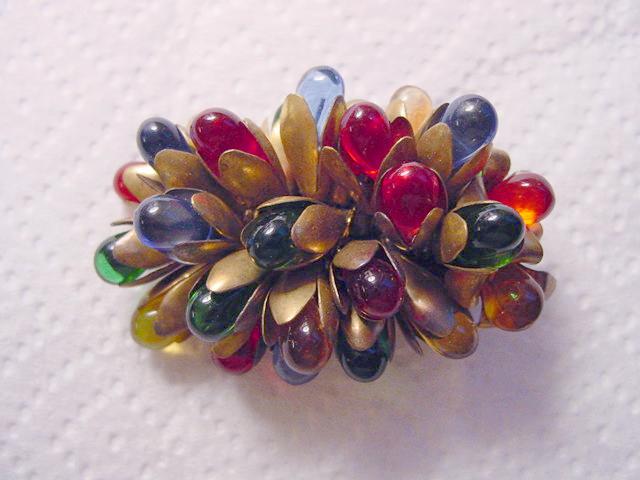
This clip is nicknamed "bubbles" by its owner!
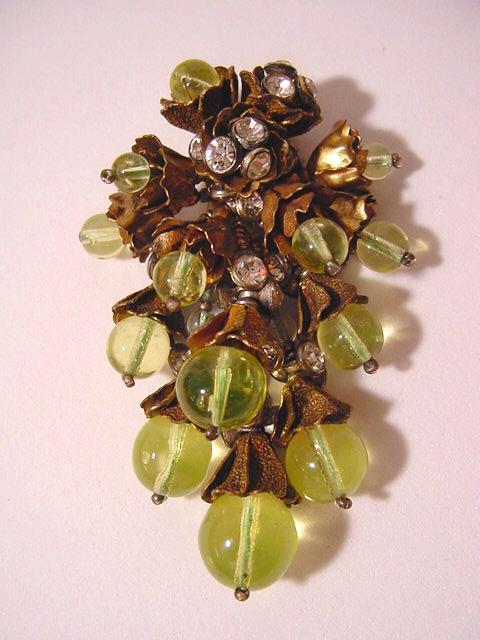
These bubble beads are translucent glass with gold tone leaves as a
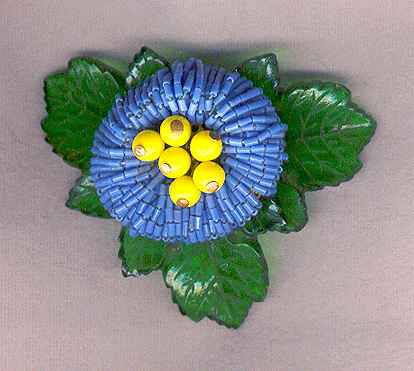
setting. You can see similar leaves used on the wood/shell clip on the
bottom of page 78 of Cera. |
This is a
very simple design for a Haskell piece. |
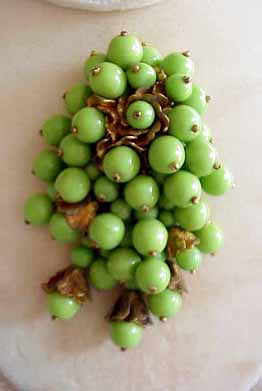
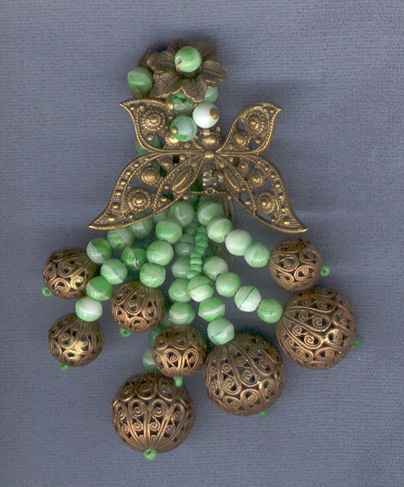
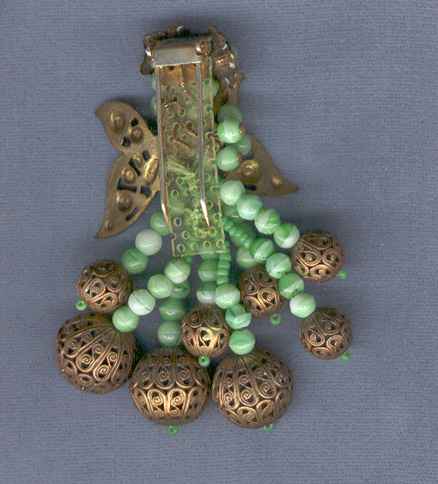
This pastel green glass bead fur clip is probably not a Haskell, but
it is wonderful nonetheless with its filigree beads and
"butterfly" motif. |
|
Haskell loved butterflies and they are
represented in numerous shapes and sizes, always with their wings
stretched open, another common Art Nouveau motif.
|
|
WOODEN
multi-colored beads 3-1/2" dress clip with green wooden leaves.
View #Y21708 |
Clips
Back
Bertl Groll, long time Haskell sample maker who was there during the
Hess era, said that she does not think this is a Haskell set. Much more
likely it is a Czech set. |
Clip
Back
Bertl Groll, long time Haskell sample maker who was there during the
Hess era, said that she thought this was a Haskell. |
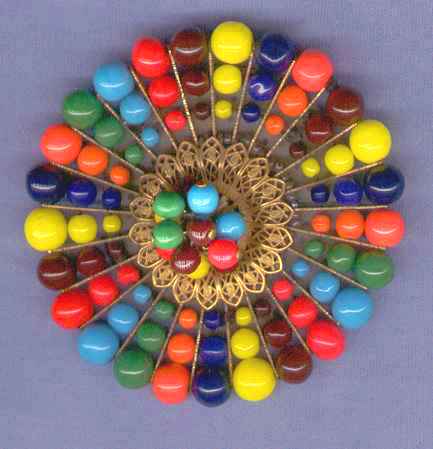
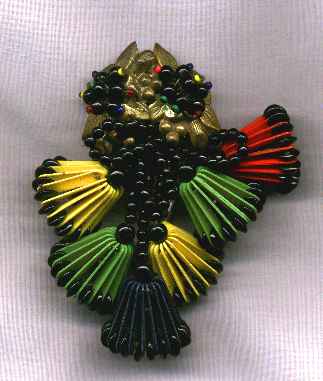
Primary colors, round, oval and square glass and wood
beads, and brass findings. What a range of designs was created! The first
two pictures look
Czech in origin, and the one on the far right is marked Czech, and also
came in solid colors.
|
FINDINGS
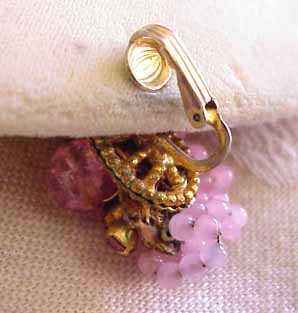
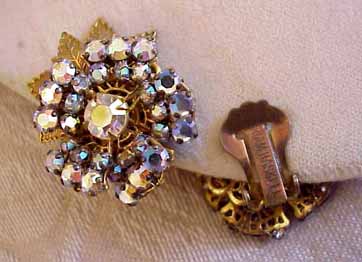
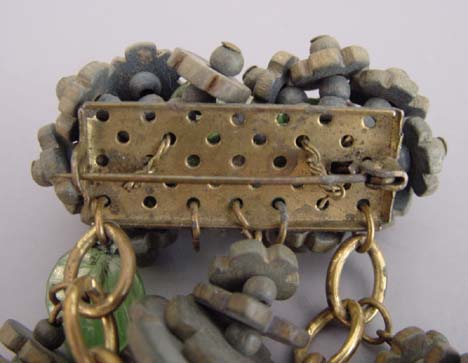
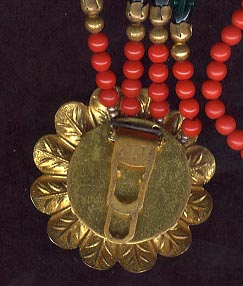
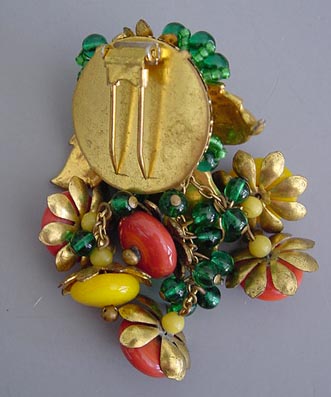
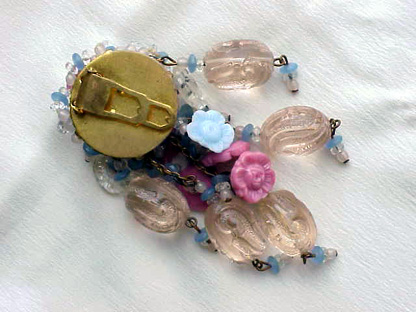
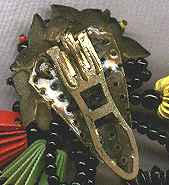
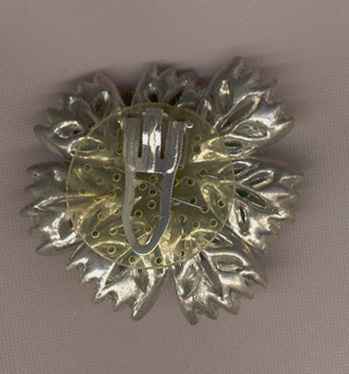
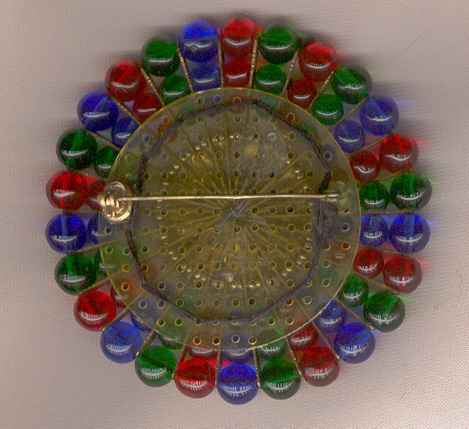
There are several styles of clip backs, and they seem to
have been used indiscriminately. The two aqua clips shown in the center
are matching, but they are strung on very different clip backs, with one
as a fur clip and the other as a dress clip.
The plastic backings were used during WWII, while solid metal and
perforated metal backings were used prior to the war.
The blue clip at the far right is one of the ones Bertl identifies as
Haskell.
|
|
This clip is unusual and lovely, with all metal parts
and no glass beads. |
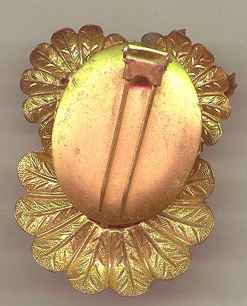
The traditional Haskell clip style on the
left. The back for the clip on the right was typically used during the
1930s. |
The clip mounted on the white beaded piece matches those used
on some of the
"lampshade" clips. |
|
The plastic dress clip backs are World War II era, and were used due to the
shortage of materials. The metal clips themselves, however, are not
indicators of era as they were used for many years.
|
All three are typical Haskell clip backs, though the clip
fronts are extremely different!
|
Two fur clips and one dress clip. Only the
one on the right is a Haskell, according to Bertl. Again, it has a plastic backing, but the metal clip is different from
those pictured on this page.
|
Copies and Inspiration
|
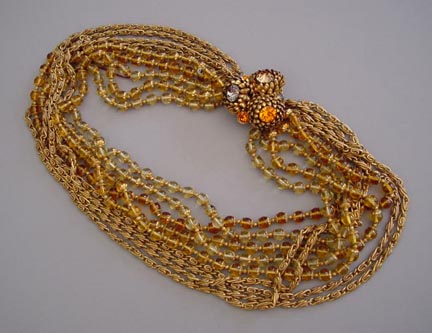
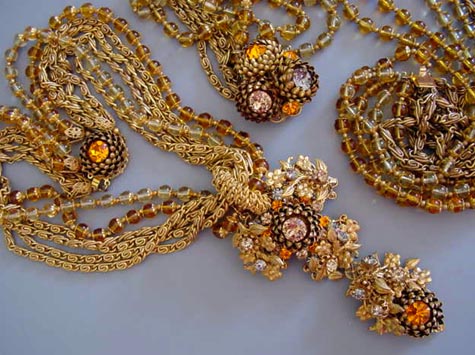
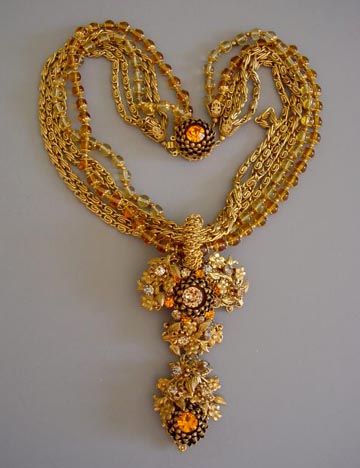
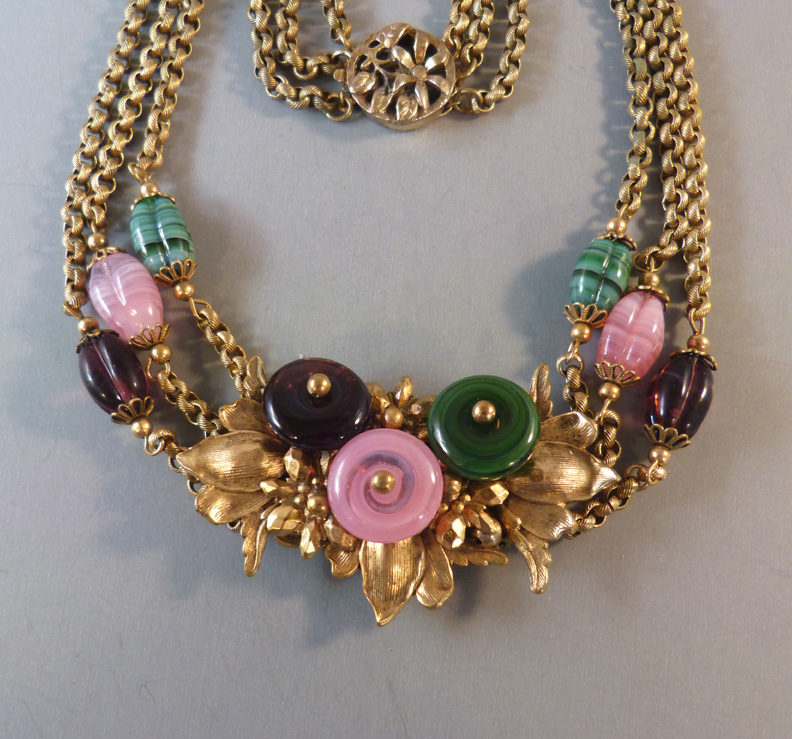
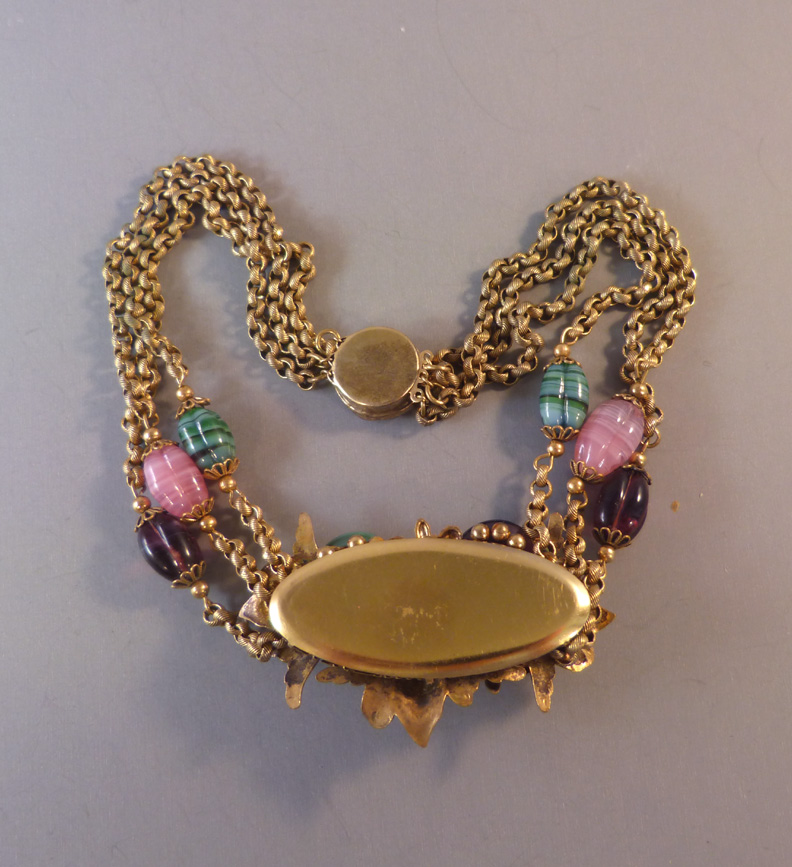
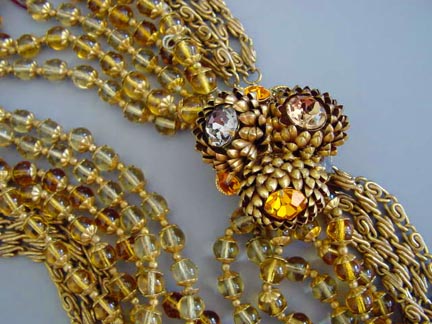
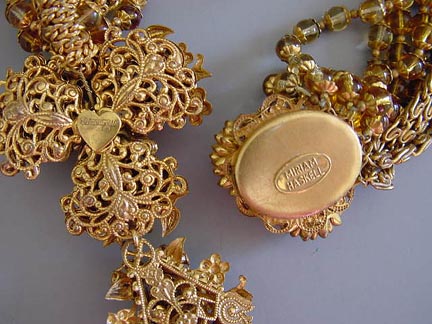
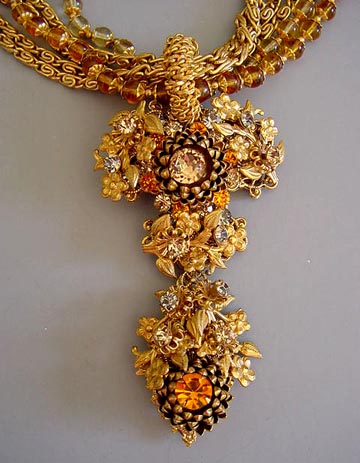
HASKELL
topaz-colored glass beads and rhinestones with gold tone chains 16"
necklace with pinecone motif clasp.
View #H22664 |
View together
View |
AMOURELLE
pinecones motif topaz- and honey-colored glass beads and rhinestones 17"
necklace with 4" pendant.
View View #X23033 |
Attributing unsigned
jewelry is always uncertain, so where possible I have shown old Haskell
advertisements and/or other documentation to add credibility to the
identifications. While beads and findings may be used as clues, they are not
definitive. An example of why can be seen in the comparison of a
Haskell and an Amourelle necklace, shown above. If the Amourelle was
unsigned, it would be easy to identify it as Haskell. Each and every bead
and finding is identical to the signed Haskell necklace.
According to those who worked in the jewelry industry, the practice of designers using each other’s pieces as inspiration
was common, as was the "borrowing" of ideas for the use
and combinations of beads,
findings and designs. The sets shown directly above, one by Haskell and one
marked Amourelle, demonstrate this. In this case though, both of these were Frank
Hess designs… one done when he worked for Haskell, and one when he worked
for Amourelle.
|
|